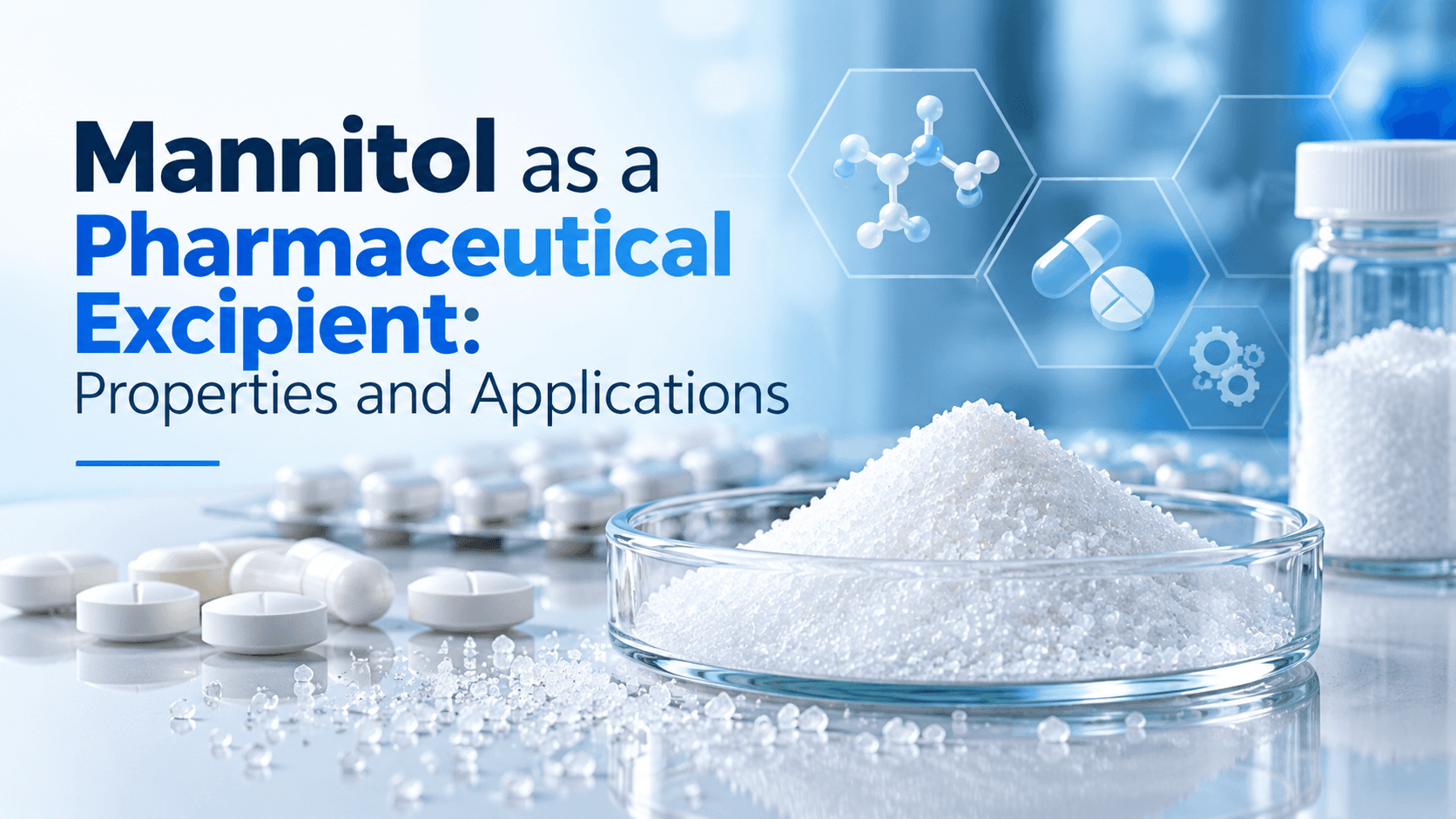
Mannitol (D-mannitol, C6H14O6, CAS 69-65-8) is a sugar alcohol used as a pharmaceutical excipient, mainly as a tablet and capsule diluent, a sweetener, a tonicity agent and a bulking agent for freeze-dried injectables. Formulators choose it for a distinctive set of properties: it absorbs very little moisture, does not undergo Maillard reactions with amine-containing drugs, dissolves with a cooling effect, and is about half as sweet as sucrose. That makes it a standard filler for moisture-sensitive actives, chewable and orally disintegrating tablets, and lyophilised products. This guide from Chelora Pharmachem, a Mumbai-based supplier of pharmaceutical excipients and intermediates, covers mannitol's properties, grades, applications, regulatory status and market, and ends with what buyers should check before ordering.
In this article+
- 01What Is Mannitol?
- 02What Are the Key Properties of Mannitol?
- 03Which Mannitol Grades Are Available?
- 04What Are the Main Applications of Mannitol?
- 05How Does Mannitol Compare With Lactose as a Filler?
- 06What Is Mannitol's Regulatory and Safety Status?
- 07How Big Is the Mannitol Market?
- 08What Should Buyers Check Before Ordering Mannitol?
- 09What Should Buyers Watch Into 2027?
Key takeaways
- Mannitol is a non-hygroscopic, non-reducing sugar alcohol, so it suits moisture- and reaction-sensitive actives better than many sugar-based fillers.
- Typical use levels are 10 to 90% w/w as a tablet diluent and 20 to 90% w/w as a bulking agent in freeze-dried products (Handbook of Pharmaceutical Excipients).
- Grade matters: crystalline, spray-dried and granulated mannitols, and the alpha, beta and delta polymorphs, behave differently in compression and freeze-drying.
- In lyophilisation, mannitol gives a strong cake but carries known risks of vial breakage and hemihydrate formation that must be designed out.
- Mordor Intelligence values the mannitol market at about USD 498 million in 2026, with pharmaceuticals the fastest-growing application at 6.41% a year.
What Is Mannitol?
Mannitol is a six-carbon polyol, or sugar alcohol, and a stereoisomer of sorbitol. It occurs naturally in small amounts in most vegetables and was historically extracted from manna, the dried sap of the manna ash.
Commercial mannitol is now made by catalytic or electrolytic hydrogenation of sugars such as glucose, fructose or mannose. US food regulations (21 CFR 180.25) also permit fermentation routes using specified microorganisms.
The same molecule is used in two very different ways. As one of the inactive pharmaceutical excipients in a formulation, it is a filler, sweetener or bulking agent. As an active pharmaceutical ingredient, it is given intravenously as an osmotic diuretic or inhaled in some respiratory products. The two uses call for different grades, specifications and regulatory files, so buyers should state clearly which one they need.
What Are the Key Properties of Mannitol?
Mannitol's defining properties are very low hygroscopicity, no Maillard reactivity, a sweet taste with a cooling feel, good water solubility and three crystal polymorphs. Together they explain where formulators use it.
| Property | Typical value or behaviour | Why it matters |
|---|---|---|
| Identity | D-Mannitol, C6H14O6, MW 182.17, CAS 69-65-8 | Quote the CAS number on every enquiry |
| Appearance | White, odourless crystalline powder or free-flowing granules | Granule and powder grades suit different processes |
| Melting point | About 165 to 170 °C | Chelora lists 165 to 169 °C; Sigma-Aldrich lists 167 to 170 °C |
| Solubility in water | About 1 part in 5.5 parts at 20 °C | Soluble enough for ODTs and injectables |
| Hygroscopicity | Resists moisture uptake even at high humidity; DC grades below 0.3% water | Protects moisture-sensitive actives |
| Maillard reaction | Does not undergo Maillard reactions | Lower risk with amine-containing drugs than reducing sugars |
| Taste and heat of solution | About half as sweet as sucrose; negative heat of solution gives a cooling feel | Good mouthfeel in chewable and orally disintegrating tablets |
| Polymorphs | Alpha, beta and delta; beta is the most stable | Affects compaction, flow and disintegration |
| Solution pH | About 5.0 to 6.5 (1 M solution) | Compatible with most formulations |
| Stability | Stable dry and in solution; solutions can be autoclaved | Suitable for sterile processing |
Values are typical and drawn from the sources noted. The governing figures are those on your supplier's Certificate of Analysis and the pharmacopoeial monograph you specify.
Which Mannitol Grades Are Available?
Mannitol is sold in crystalline, crystallised, spray-dried and granulated grades, each with distinct flow and compaction behaviour. Choosing the grade is a formulation decision, not a commodity purchase.
Crystalline mannitol is used where it will be granulated or dissolved. Spray-dried grades, with their high surface area, compress into stronger tablets than granulated or crystallised grades in dry granulation and roller compaction, according to Merck's technical guide. Particle-engineered direct-compression grades such as Merck's Parteck M, which is 100% beta-mannitol, are designed to give hard tablets that disintegrate quickly and to blend uniformly with micronised actives.
For freeze-drying, buyers usually specify a parenteral-suitable grade. Confirm with the supplier which pharmacopoeial tests are covered for the intended route, such as microbial limits and bacterial endotoxins, rather than assuming a tablet grade is suitable. Chelora Pharmachem lists mannitol in pharma and spray-dried grades.
What Are the Main Applications of Mannitol?
Mannitol is used mainly as a tablet and capsule diluent, as the base of chewable and orally disintegrating tablets, and as a bulking agent in freeze-dried injectables, with smaller roles as a tonicity agent and plasticiser.
Tablet and capsule diluent
Mannitol is used at 10 to 90% w/w as a diluent in direct compression and wet granulation. Its low hygroscopicity makes it a preferred filler for moisture-sensitive actives, and its chemical inertness reduces the risk of interactions. Merck reports that its directly compressible grade can carry up to 60% of a non-directly compressible active and blend uniformly with micronised actives below 15 µm.
Chewable and orally disintegrating tablets
Its sweetness, cooling sensation and mouthfeel make mannitol a common base for chewable tablets, and its rapid disintegration in directly compressed form suits orally disintegrating tablets. These formats are often paired with a superdisintegrant such as croscarmellose sodium and a lubricant such as magnesium stearate.
Freeze-dried (lyophilised) injectables
As a bulking agent at 20 to 90% w/w, mannitol crystallises during freezing to form a stiff, uniform cake that supports appearance, mechanical strength and reconstitution, and it is generally preferred to glycine for this role.
A 2023 review in the Journal of Pharmaceutical Sciences (Thakral and co-authors) highlights two risks: vial breakage caused by mannitol crystallisation during freezing, and the formation of a metastable mannitol hemihydrate in the final cake. Both need to be managed through formulation and freeze-drying cycle design, including how the frozen solution is held and dried.
Other uses
Mannitol is also used as a tonicity agent, to prevent thickening of aluminium hydroxide antacid suspensions at 4 to 7% w/v, as a plasticiser in soft gelatin capsules and in some sustained-release tablets. In foods it serves as a sweetener, anticaking agent and bulking agent.
How Does Mannitol Compare With Lactose as a Filler?
Mannitol is non-reducing and non-hygroscopic, while lactose is a reducing sugar that can react with amine drugs. That difference decides most choices between the two common sugar-based fillers.
| Property | Mannitol | Lactose monohydrate |
|---|---|---|
| Chemical type | Sugar alcohol (polyol) | Disaccharide sugar |
| Reducing behaviour | Non-reducing; no Maillard reaction | Reducing sugar; can undergo Maillard reactions with primary and secondary amines |
| Moisture behaviour | Non-hygroscopic | Contains water of crystallisation |
| Taste | Sweet with a cooling feel | Mildly sweet |
| Typical strengths | Moisture-sensitive actives, chewables, ODTs, lyophilisates | General oral solid dose filler |
| Points to check | Grade and polymorph, cost, laxative effect at high oral intake | Interactions with amine drugs; labelling for lactose intolerance where required |
Lactose monohydrate remains the general-purpose choice for many oral solid doses. Sorbitol, mannitol's isomer, is also used in chewables and liquids, but it is much more hygroscopic, which limits its use in moisture-sensitive solid doses.
What Is Mannitol's Regulatory and Safety Status?
Mannitol has monographs in the major pharmacopoeias, is listed as GRAS and appears in the FDA Inactive Ingredient Database for several routes. Its main known effect at high oral intake is a laxative one.
The Handbook of Pharmaceutical Excipients lists mannitol monographs in the British, European, Japanese and United States pharmacopoeias. It is accepted as a food additive in Europe and included in UK-licensed parenteral and non-parenteral medicines. In US foods, 21 CFR 180.25 permits mannitol on an interim basis with maximum levels by food type, and requires the statement "Excess consumption may have a laxative effect" where reasonably foreseeable consumption could give a daily intake of 20 g.
Large oral doses act as an osmotic laxative. Adverse reactions have mainly followed therapeutic intravenous infusions of 20% w/v solutions, and hypersensitivity reactions have been reported with mannitol as an excipient. The WHO has not specified an acceptable daily intake. Hazard classification differs between supplier listings, so rely on your supplier's SDS; the Handbook recommends eye protection because the powder may irritate the eyes.
How Big Is the Mannitol Market?
Mordor Intelligence values the global mannitol market at about USD 498.2 million in 2026, rising to USD 638.03 million by 2031, with pharmaceuticals the fastest-growing application.
| Measure | Figure | Note |
|---|---|---|
| Market size, 2026 | USD 498.2 million | Mordor Intelligence (USD 474.11 million in 2025) |
| Forecast, 2031 | USD 638.03 million | 5.08% CAGR, 2026 to 2031 |
| Largest application | Food and beverage, 42.31% of 2025 revenue | No 2025 pharmaceutical share published |
| Fastest-growing application | Pharmaceuticals, 6.41% CAGR to 2031 | — |
| Largest region | North America, 35.12% of 2025 revenue | Asia-Pacific fastest-growing at 6.05% a year |
This is a single-publisher estimate. Treat it as orientation rather than a contract input.
What Should Buyers Check Before Ordering Mannitol?
Seven checks prevent most ordering problems: pharmacopoeia, grade, route, impurities, documents, supply consistency and packaging.
- 1
Pharmacopoeia and edition
Specify USP-NF, Ph. Eur., BP, JP or another required standard, and the current edition.
- 2
Grade and polymorph
State crystalline, spray-dried or granulated, the particle size range and, where it matters, the polymorph.
- 3
Route of administration
For parenteral use, confirm the grade covers the required microbial and endotoxin testing.
- 4
Impurities
Ask for limits on reducing sugars and related polyols such as sorbitol, which matter for sensitive actives and peptides.
- 5
Documents
Request the batch COA, SDS, specification sheet and, where applicable, a Drug Master File reference or regulatory support letter.
- 6
Supply consistency
Confirm the manufacturer, site and grade will stay the same between batches, since a change of source can affect tablet properties.
- 7
Packaging and storage
Confirm lined, sealed packaging and storage in a cool, dry place in a well-closed container.
To discuss a grade or request a sample, send the product name, CAS number, grade, quantity and destination through the contact page. You can also browse the full product list.
What Should Buyers Watch Into 2027?
Watch pharmaceutical demand, which Mordor Intelligence expects to grow faster than food demand, continued use of orally disintegrating and chewable formats, and growth in freeze-dried biologics that rely on mannitol as a bulking agent.
Because mannitol is made from sugars, feedstock costs and supply also matter. The practical lever for buyers stays the same: specify the pharmacopoeia, grade and route clearly, and keep the source consistent once a formulation is validated.
Frequently asked questions
What is mannitol used for in pharmaceuticals?+
As an excipient, mannitol (CAS 69-65-8) is used mainly as a tablet and capsule diluent, a sweetener, a tonicity agent and a bulking agent for freeze-dried injectables. It is especially common in chewable and orally disintegrating tablets because of its sweetness and cooling mouthfeel. Mannitol is also used as an active ingredient, for example as an osmotic diuretic, but that requires a different grade and regulatory route.
Why is mannitol preferred for moisture-sensitive drugs?+
Mannitol resists moisture uptake even at high relative humidity, unlike its isomer sorbitol, and directly compressible grades can have water contents below 0.3%. It also does not undergo Maillard reactions, so it is less likely than reducing sugars such as lactose to react with amine-containing drugs. Together these properties make it a common choice for moisture- or reaction-sensitive actives.
What are the polymorphs of mannitol, and why do they matter?+
Mannitol has at least three anhydrous polymorphs, alpha, beta and delta, of which beta is the most stable. Polymorph and particle engineering affect compactability, flow and disintegration, which is why spray-dried and granulated grades behave differently from crystalline mannitol. In freeze-drying, mannitol can also form a metastable hemihydrate, which needs to be controlled during cycle design.
How much mannitol is used in a tablet formulation?+
The Handbook of Pharmaceutical Excipients gives a typical range of 10 to 90% w/w for mannitol as a tablet diluent, used in both direct compression and wet granulation. One supplier of a directly compressible grade reports formulations carrying up to 60% of a non-directly compressible active. The right level depends on the active, the grade and the process, so confirm it in development.
Why is mannitol used in chewable and orally disintegrating tablets?+
Mannitol dissolves endothermically, giving a cooling sensation, is about half as sweet as sucrose, and has a pleasant mouthfeel. It is non-hygroscopic, which helps tablets stay stable in humid conditions. Directly compressible grades also produce hard tablets that disintegrate quickly, which suits orally disintegrating formats.
Why is mannitol used as a bulking agent in freeze-dried injectables?+
Mannitol crystallises during freezing and forms a stiff, uniform cake that supports the product's appearance and reconstitution; the Handbook gives a typical range of 20 to 90% w/w. A 2023 Journal of Pharmaceutical Sciences review notes two risks to manage: vial breakage during freezing and formation of a metastable hemihydrate in the final cake. Both are addressed through formulation and freeze-drying cycle design.
Is mannitol safe as an excipient?+
Mannitol is listed as GRAS, accepted as a food additive in Europe and included in the FDA Inactive Ingredient Database for several routes. Large oral doses act as an osmotic laxative, and US food regulations require a laxative-effect statement where daily intake could reach 20 g. Hypersensitivity reactions have been reported. Always check the supplier's SDS and the maximum levels for your route.
Which pharmacopoeias have a mannitol monograph?+
The Handbook of Pharmaceutical Excipients lists mannitol monographs in the British, European, Japanese and United States pharmacopoeias. Specify the pharmacopoeia your market requires, and confirm the current edition of the monograph with your supplier, since requirements such as impurity limits and tests are revised over time.
How big is the mannitol market?+
Mordor Intelligence values the global mannitol market at about USD 498.2 million in 2026, rising to USD 638.03 million by 2031, a 5.08% compound annual growth rate. Food and beverage held 42.31% of 2025 revenue, while pharmaceuticals are forecast to grow fastest, at 6.41% a year. North America held 35.12% of revenue in 2025.
Does Chelora Pharmachem supply mannitol?+
Yes. Chelora Pharmachem lists mannitol (CAS 69-65-8) in its pharmaceutical excipients range as a filler, sweetener and bulking agent for chewable tablets, orally disintegrating tablets and freeze-dried products. Pharmacopoeia grades are offered where a monograph exists. Send the grade, quantity and destination through the contact page and the team will confirm specification and documents.
Need Pharmaceutical-Grade Mannitol?
Chelora Pharmachem supplies mannitol (CAS 69-65-8) as a filler, sweetener and bulking agent, alongside other excipients including microcrystalline cellulose, lactose monohydrate, croscarmellose sodium, magnesium stearate and HPMC. Pharmacopoeia grades are offered where a monograph exists, sourced from qualified manufacturers with full documentation. Send the grade, quantity and destination and the team will confirm specification and lead time.
- #mannitol
- #pharmaceutical excipients
- #tablet diluent
- #orally disintegrating tablets
- #chewable tablets
- #lyophilisation
- #bulking agent
- #sugar alcohols
- #polyols
- #direct compression