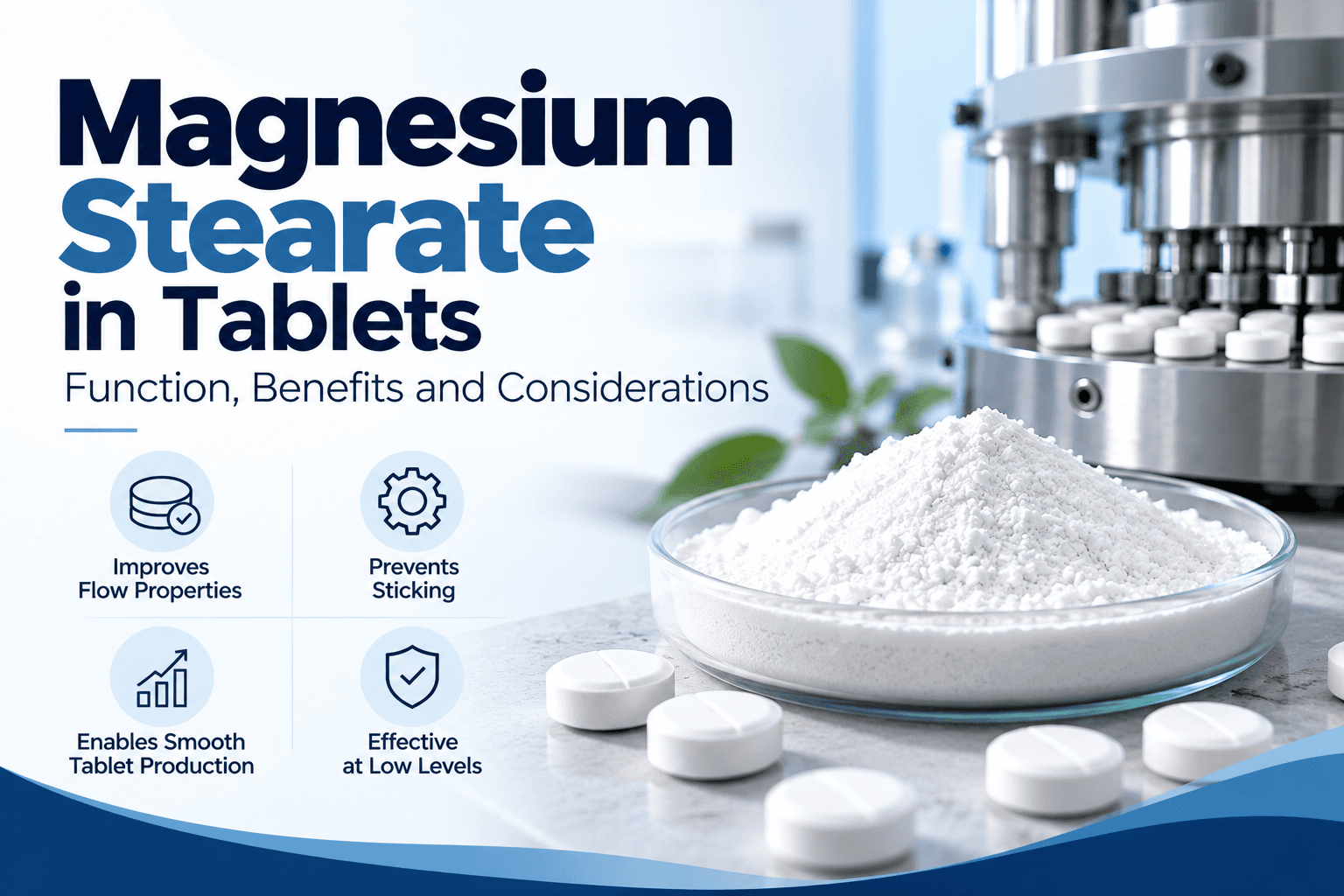
Magnesium stearate is the most widely used tablet lubricant in the pharmaceutical industry. It is the magnesium salt of stearic acid and palmitic acid, a fine white powder added at roughly 0.25 to 2 percent to stop tablet blends sticking to punches and dies and to lower the force needed to eject a compressed tablet. Without a lubricant, most formulations would jam, scuff or break on a high-speed press. The benefit comes with a trade-off. Because it coats particles with a water-repelling film, too much of it, or too much mixing, can soften tablets and slow dissolution. This guide explains how the excipient works, what its benefits and limits are, how to set the level, what specifications to check when buying, and how to troubleshoot lubrication problems. It is written for formulation scientists, production teams and procurement staff at tablet and capsule manufacturers.
In this article+
- 01What Is Magnesium Stearate and Why Is It Used in Tablets?
- 02How Does Magnesium Stearate Work as a Tablet Lubricant?
- 03What Are the Benefits of Magnesium Stearate in Tablet Manufacturing?
- 04What Are the Drawbacks and Considerations When Using Magnesium Stearate?
- 05How Much Magnesium Stearate Should Be Used in a Tablet?
- 06What Are the Alternatives to Magnesium Stearate?
- 07What Specifications Should Buyers Check for Pharmaceutical-Grade Magnesium Stearate?
- 08How Do You Optimize and Troubleshoot Lubrication in a Tablet Formulation?
- 09How Should Magnesium Stearate Be Stored and Handled?
- 10How Has the Use of Magnesium Stearate in Tablets Developed?
| Product name | Magnesium stearate |
| Synonyms | Magnesium octadecanoate, magnesium salt of stearic acid, stearic acid magnesium salt |
| CAS number | 557-04-0 |
| Molecular formula | C36H70MgO4 |
| Chemical type | Magnesium salt of long-chain fatty acids (a mixture of stearate and palmitate salts) |
| Appearance | Fine, light, white powder with a slightly greasy feel |
| Main functions | Tablet and capsule lubricant, anti-adherent |
| Typical use level | 0.25 to 2 percent of the blend, with many formulations near 0.5 to 1 percent |
| Added at | The final blend step, last, at low intensity and for a short, fixed time |
| Key quality attributes | Magnesium content, fatty acid composition, specific surface area, particle size, water content, microbial limits |
| Pharmacopoeial status | Monographs in IP, BP, Ph. Eur. and USP-NF |
| Available from Chelora Pharmachem | Magnesium stearate product page |
What Is Magnesium Stearate and Why Is It Used in Tablets?
Magnesium stearate is a pharmaceutical excipient, a magnesium salt of long-chain fatty acids with the formula C36H70MgO4 (CAS 557-04-0), used in tablets and capsules as a lubricant and anti-adherent. It is added so that powder blends can be compressed and ejected cleanly without sticking to the tooling.
In pharmacopoeial terms, the material is not a single pure compound. The monographs define it as a mixture of magnesium salts of stearic and palmitic acids, with limits on the magnesium content and on the fatty acid composition. This matters in practice, because the ratio of stearate to palmitate, the water of hydration and the particle surface area all change how the powder lubricates. Two lots that both pass the monograph can still behave differently on the press.
On the Chelora Pharmachem product list, magnesium stearate sits in the pharmaceutical excipients range as a lubricant and anti-adherent with a typical use level of 0.25 to 2 percent, alongside binders, fillers and disintegrants such as microcrystalline cellulose, povidone and HPMC.
How Does Magnesium Stearate Work as a Tablet Lubricant?
Magnesium stearate works as a boundary lubricant: its soft, plate-like particles spread over the surface of the other ingredients and the metal tooling, forming a thin film that lets surfaces slide past one another. This film reduces friction at the die wall and prevents powder from adhering to punch faces.
During blending, the lubricant particles shear into thin layers and smear across granules. During compression, the film reduces friction between the tablet edge and the die wall, which lowers the ejection force. A low ejection force protects the tablet from capping and lamination, and it reduces wear on punches and dies. At the punch faces, the same film acts as an anti-adherent, reducing sticking and picking, particularly with logos and embossing.
The effect depends on how much of the surface it covers. Small amounts give partial coverage, and as the level or blending time increases, coverage approaches a continuous film. Lubrication improves with coverage, but so does the unwanted effect on bonding, and finding the balance is the central task of lubricant selection.
What Are the Benefits of Magnesium Stearate in Tablet Manufacturing?
The main benefits of magnesium stearate are lower ejection force, protection of tooling, reduced sticking, smoother high-speed operation and effectiveness at low levels. These add up to fewer stoppages and more consistent tablets.
Lower ejection force. Reducing friction at the die wall allows tablets to leave the die without damage. This is critical at high press speeds, where friction generates heat and stress.
Reduced sticking and picking. The excipient keeps blends from adhering to punch faces, which preserves tablet appearance and weight uniformity and prevents damage to embossed tooling.
Efficiency at low levels. A fraction of a percent is often enough, so the lubricant takes up little formulation space and has limited impact on other properties when used correctly.
Better flow and capsule filling. In capsule manufacturing, the powder flows more smoothly into the dosing system and releases cleanly from tamping pins and dosators, which improves fill-weight consistency.
Wide acceptance. It has monographs in the major pharmacopoeias, a long record of use in regulated products and broad supplier availability, which simplifies registration and sourcing.
What Are the Drawbacks and Considerations When Using Magnesium Stearate?
The main considerations are over-lubrication, effects on dissolution, chemical compatibility, variability between sources and dust handling. Each can be managed, but each needs attention at formulation stage.
Over-lubrication. Over-lubrication occurs when the film covers too much of the particle surface, usually from excess lubricant or prolonged mixing. The result is lower tablet hardness, higher friability, and slower disintegration and dissolution. Formulations differ in how strongly they react to this, a property called lubricant sensitivity. Plastic-deforming materials such as microcrystalline cellulose are generally more sensitive than brittle fillers such as lactose or dibasic calcium phosphate, because their bonding relies on clean surfaces.
Dissolution. Because the film repels water, a heavily lubricated tablet may wet and disintegrate slowly, and the effect can be larger for poorly soluble drugs. Dissolution should always be tested on the final formulation, not assumed.
Chemical compatibility. The magnesium salt is basic and can react with acidic or moisture-sensitive drugs. It is known to be unsuitable for some products, such as those containing aspirin, because it can accelerate hydrolysis, and it should not be combined with strong acids, strong alkalis or iron salts. Run compatibility studies for any new active ingredient.
Source variability. Specific surface area, particle size and hydrate form vary between manufacturers and even between lots, and they affect lubrication efficiency. Changing supplier or grade can therefore change tablet properties, which is why qualification and documentation matter.
Dust and handling. The powder is fine and light. Like other organic powders, it forms combustible dust clouds, so handling should limit dust, control ignition sources and use suitable personal protective equipment.
How Much Magnesium Stearate Should Be Used in a Tablet?
Most formulations use 0.25 to 2 percent magnesium stearate by weight, with many at about 0.5 to 1 percent, and the correct level is the lowest one that gives acceptable ejection force and no sticking. The level is set by trials, not by a fixed rule.
Several factors move the number. Direct compression blends, which lack the binding added by granulation, are usually more sensitive to over-lubrication, so they tend to use less lubricant and a shorter blend. Wet granulation produces denser, stronger granules that tolerate a little more lubricant. High compression forces and fast presses call for more efficient lubrication. Hydrophobic or sticky actives may need more, and highly soluble or fragile formulations may need less. The surface area of the grade matters too, since a finer, higher-surface-area grade covers more at the same percentage.
In practice, formulation teams run a short design of experiments across two or three levels and two or three blending times, measure ejection force, tablet hardness, friability, disintegration and dissolution, and choose the setting that satisfies all of them with margin. A good formulation shows a flat response, meaning small changes in blending time do not move the results much.
What Are the Alternatives to Magnesium Stearate?
The common alternatives to magnesium stearate are stearic acid, sodium stearyl fumarate, glyceryl behenate and talc, and the right choice depends on how much dissolution retardation and sensitivity the formulation can accept. None is a drop-in replacement, so each needs its own trials.
| Lubricant | Strengths | Limitations | Typical level |
|---|---|---|---|
| Magnesium stearate | Very efficient, low cost, widely accepted | Hydrophobic film, lubricant sensitive, basic salt | 0.25 to 2% |
| Stearic acid | Less hydrophobic effect, simple chemistry | Less efficient, melts at low temperature | 1 to 3% |
| Sodium stearyl fumarate | Hydrophilic, small dissolution effect | Higher cost, less efficient per gram | 0.5 to 2% |
| Glyceryl behenate | Lipid lubricant with milder film | Needs higher levels, cost | 1 to 3% |
| Talc | Anti-adherent and glidant | Weak lubricant, not for all uses | 1 to 5% |
Switching to sodium stearyl fumarate is the usual first move when dissolution is the limiting issue. Some teams blend a small amount of magnesium stearate with a more hydrophilic lubricant to balance efficiency and release. Whatever route is chosen, test the final blend on the actual press. These ranges are typical literature values, not specifications. Confirm them against your own data and the supplier's documentation.
What Specifications Should Buyers Check for Pharmaceutical-Grade Magnesium Stearate?
Buyers should check pharmacopoeial compliance, magnesium content, fatty acid composition, physical properties such as specific surface area and particle size, hydrate or water content, microbial limits and a written statement of the fatty acid source. Each shapes both performance and regulatory acceptance.
Start with the pharmacopoeia. Excipients are normally bought to a monograph, such as IP, BP, Ph. Eur. or USP-NF, where one applies, and the Certificate of Analysis should state which edition the batch complies with. The monograph limits the magnesium content and the stearic and palmitic acid composition, and sets limits for impurities such as heavy metals and for microbial quality. For Indian market products, the monographs and updates are published by the Indian Pharmacopoeia Commission.
Then look beyond the monograph. Specific surface area and particle size strongly influence lubricating efficiency, but monographs do not always fix them, so agree a range with the supplier and request the figure on each COA. Water content and hydrate form matter because they affect both lubrication and stability. Ask for the source of the fatty acids, vegetable or animal, and for any TSE or BSE statement that your markets require. Finally, confirm that the supplier provides a batch-specific COA, a GHS-format Safety Data Sheet and, if you audit suppliers, evidence of GMP-compliant manufacture.
Chelora Pharmachem supplies excipients with a certificate of analysis and a safety data sheet with every order, can supply to IP, BP/Ph. Eur. and USP monographs where one exists, and sources from qualified manufacturers. Each product is checked name-to-CAS-to-formula before it is offered, and QC samples are available so your laboratory can test the material before a bulk order. You can read more about the company on the About page, or browse the full product list.
How Do You Optimize and Troubleshoot Lubrication in a Tablet Formulation?
You optimize lubrication by setting the lowest effective level, controlling the blend step, and confirming the result with measured data on ejection force, hardness and dissolution. A fixed six-step sequence keeps the work organized.
- 1
Define the problem and the targets
Decide what you must fix, such as sticking at the punch face, high ejection force or capping, and set targets for ejection force, hardness, friability and dissolution.
- 2
Check compatibility with the active ingredient
Run a short compatibility study with magnesium stearate, especially for acidic, moisture-sensitive or reactive actives, before any scale-up.
- 3
Screen the level and the blending time
Test two or three levels, for example 0.25, 0.5 and 1 percent, and two or three blending times, with the lubricant added last at low intensity.
- 4
Measure the full response
Record ejection force, tablet tensile strength or hardness, friability, disintegration time and the dissolution profile for each combination.
- 5
Fix the process in the batch record
Lock the lubricant level, the blender type and speed, and the final blending time, because lubrication depends on blending shear as well as on the number of minutes.
- 6
Qualify the grade and the supplier
Agree a specification that includes surface area and particle size, hold a retained sample, and re-test whenever the grade or source changes.
If dissolution fails while ejection force is acceptable, over-lubrication is the likely cause, so reduce the blending time or level, or switch to a more hydrophilic lubricant. If sticking persists at low levels, check moisture, punch-face condition and the surface area of the grade. If tablet hardness drops from batch to batch, compare the blending times and the lubricant lot.
To discuss a grade or request a sample for evaluation, send the product name, CAS number, grade and quantity through the contact page. The typical response time is one business day.
How Should Magnesium Stearate Be Stored and Handled?
Store magnesium stearate in tightly closed containers in a cool, dry, well-ventilated place away from strong acids, strong alkalis and oxidizing materials, and handle it in a way that limits dust. These conditions protect the powder's quality and reduce safety risk.
The powder takes up moisture from humid air, and changes in water content can alter its behavior, so keep drums, bags and liners sealed between uses and avoid storing near wet processes. Use dust-control measures at transfer points, ground equipment, and keep ignition sources away, because fine organic powders can form combustible dust clouds. Wear appropriate respiratory and eye protection, and follow the Safety Data Sheet. Magnesium stearate is not classed as dangerous goods for transport, but confirm the status for your shipment on the SDS.
How Has the Use of Magnesium Stearate in Tablets Developed?
Magnesium stearate has been a standard tablet lubricant for most of the last century, and the understanding of how it works has moved from trial and error to a data-driven, specification-based approach. The history falls into three periods.
Early twentieth century to the 1960s: a practical lubricant
As tablet presses became faster and tablets more common, manufacturers needed something that would stop powder sticking to tooling and reduce ejection damage. Metal stearates, and magnesium stearate in particular, proved cheap, effective and easy to blend, and they became standard in compendia and in everyday practice.
1970s to 1990s: understanding the film and its limits
Research in these decades showed that the lubricant forms a film on particle surfaces, that blending time and intensity change its effect, and that the film weakens tablet strength and can slow dissolution. The concept of lubricant sensitivity emerged, and with it the practice of adding the lubricant last and limiting the final mix. Pharmacopoeial harmonization also began to align the monographs across regions.
2000s to today: quality by design and supplier control
Quality-by-design thinking, formalized in ICH guidance in the late 2000s, pushed manufacturers to treat excipient properties such as surface area and particle size as critical material attributes. Excipient GMP guidance, elemental impurity control and tighter supplier qualification followed. Today, buyers expect a batch-specific COA, source declarations and documented change control, and they treat the choice of magnesium stearate grade as a formulation decision, not a commodity purchase.
Frequently asked questions
What is magnesium stearate used for in tablets?+
Magnesium stearate is used in tablets as a lubricant and anti-adherent. It reduces friction between the tablet and the die wall during ejection, and it stops powder from sticking to punch faces and other metal surfaces. In capsule filling it helps the powder flow and release from dosing parts. It is typically added at about 0.25 to 2 percent of the blend, usually as the last ingredient and with a short final mix.
Is magnesium stearate safe in pharmaceutical products?+
Yes, at the levels used in tablets and capsules. Magnesium stearate is a long-established pharmaceutical excipient with monographs in major pharmacopoeias, and it is accepted by regulators for oral dosage forms. The amount in a single dose is small, usually a few milligrams. Safety in practice depends on using a grade that meets the monograph, with documented source, impurity limits and a batch Certificate of Analysis, and on keeping the level within what the formulation needs.
Can too much magnesium stearate affect tablet dissolution?+
Yes. Magnesium stearate is hydrophobic, and with too much lubricant or too long a blending time it forms a film around granules. That film weakens the bonds between particles, which lowers tablet hardness, and it slows water penetration, which can delay disintegration and dissolution. This is called over-lubrication. It is controlled by using the lowest effective level, adding the lubricant last, keeping the final blend short and confirming dissolution with trials.
What is a typical magnesium stearate concentration in tablets?+
Most formulations use between 0.25 and 2 percent magnesium stearate by weight, and many sit near 0.5 to 1 percent. The right level depends on the formulation, the tablet press, the compression force and the surface area of the grade. Direct compression blends with fine, sticky or poorly flowing ingredients may need more, while hydrophobic or highly sensitive formulations may need less. Always set the level by trials that measure ejection force, hardness and dissolution.
What are the alternatives to magnesium stearate?+
Common alternatives include stearic acid, sodium stearyl fumarate, glyceryl behenate and, in some cases, talc or hydrogenated vegetable oils. Sodium stearyl fumarate is more hydrophilic and often causes less dissolution retardation. Stearic acid is less efficient and usually needs a higher level. Each alternative has its own trade-offs in efficiency, cost and compatibility, so the choice is made by comparing lubrication, hardness and dissolution data on your own formulation.
Is magnesium stearate vegetarian?+
It depends on the source of the stearic acid. Magnesium stearate can be made from vegetable fatty acids or from animal-derived tallow. Buyers who need vegetarian, vegan, halal or kosher status should ask the supplier for a written declaration of the fatty acid source, along with any TSE or BSE statement the market requires, and should not assume the grade is plant-derived unless it is documented.
Need Professional Help with Magnesium Stearate Sourcing?
Chelora Pharmachem is a Mumbai-based supplier of pharmaceutical excipients, intermediates and vitamin ingredients for formulation and API manufacturers. Every order comes with a certificate of analysis and a safety data sheet, and products are sourced from qualified manufacturers. Send the product, grade, specification and quantity, and the team replies with availability and documentation, typically within one business day. Sample quantities are available for QC evaluation.
- #magnesium stearate
- #tablet lubricant
- #over-lubrication
- #ejection force
- #tablet hardness
- #dissolution
- #direct compression
- #pharmaceutical excipient
- #sodium stearyl fumarate
- #lubricant sensitivity