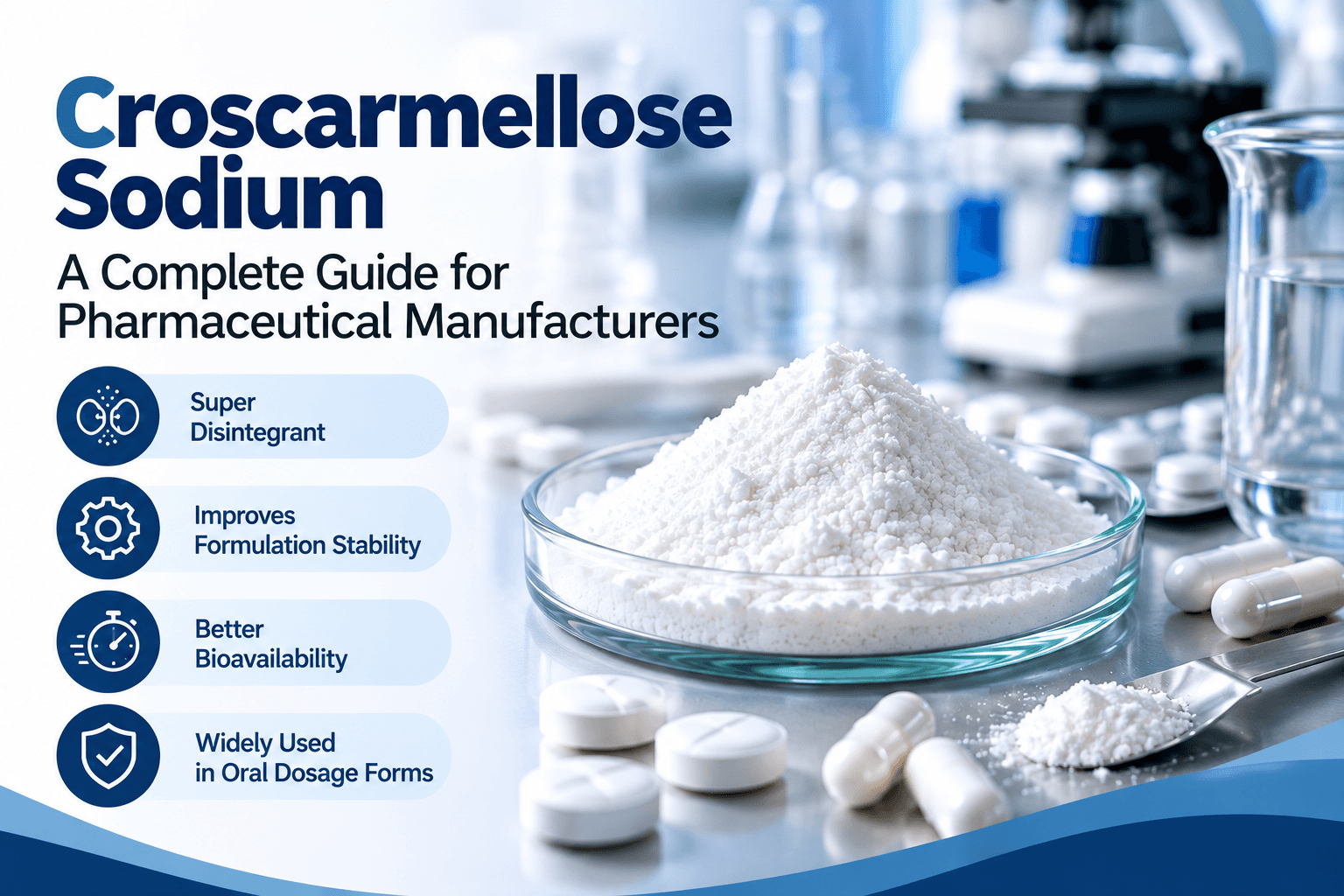
For pharmaceutical manufacturers making immediate-release tablets and capsules, croscarmellose sodium is one of the most dependable superdisintegrants available. It is a cross-linked form of sodium carboxymethylcellulose, and its role is simple but critical: to make a tablet or capsule break apart rapidly once it reaches the gastrointestinal tract, so the active ingredient is released and absorbed without delay. Croscarmellose sodium does this through a combination of fast water wicking and strong swelling, and because it is cross-linked it swells powerfully without forming the viscous gel that would otherwise slow disintegration. It works at low concentrations, performs well in both direct compression and granulation, and is compatible with most active ingredients, which is why it appears in so many solid oral formulations. This guide is written for formulation and manufacturing teams: it explains what croscarmellose sodium is, how it works as a superdisintegrant, how to use it in tablet manufacturing, how it compares with other disintegrants, and what to check on quality, compatibility and storage — along with what to expect from a pharmaceutical-grade supplier such as Chelora Pharmachem.
In this article+
- 01What Is Croscarmellose Sodium?
- 02How Does Croscarmellose Sodium Work as a Superdisintegrant?
- 03Why Do Pharmaceutical Manufacturers Use Croscarmellose Sodium?
- 04How Is Croscarmellose Sodium Used in Tablet Manufacturing?
- 05How Does Croscarmellose Sodium Compare with Other Superdisintegrants?
- 06How Should You Select and Incorporate Croscarmellose Sodium?
- 07How Did Superdisintegrants Like Croscarmellose Sodium Develop?
| Product name | Croscarmellose Sodium |
| Synonyms | Cross-linked sodium carboxymethylcellulose, Croscarmellose sodium, CCS, modified cellulose gum |
| CAS number | 74811-65-7 |
| Chemical type | Cross-linked sodium carboxymethylcellulose (anionic, fibrous polymer) |
| Functional category | Superdisintegrant (tablet and capsule disintegrant) |
| Appearance | White to off-white, free-flowing, hygroscopic powder |
| Solubility | Insoluble in water (swells rapidly); practically insoluble in organic solvents |
| Mechanism | Rapid water wicking and strong swelling, without gel formation |
| Typical use level | About 2 to 5 percent of tablet weight (process-dependent) |
| Pharmacopoeial status | Complies with USP-NF, Ph. Eur., BP, IP and JP Croscarmellose Sodium monographs |
| Main dosage forms | Immediate-release tablets, capsules and granules |
| Available from Chelora Pharmachem | Croscarmellose Sodium product page |
What Is Croscarmellose Sodium?
Croscarmellose sodium is an internally cross-linked form of sodium carboxymethylcellulose, used in pharmaceutical formulations as a superdisintegrant. It is a white to off-white, fibrous, free-flowing powder that is insoluble in water but swells rapidly on contact with it, and it is physiologically inert and well tolerated.
The starting material, sodium carboxymethylcellulose, is a water-soluble cellulose derivative. Introducing cross-links between the polymer chains changes its behaviour completely: the material can still take up large amounts of water and swell, but it can no longer dissolve or form a continuous gel. That distinction is the key to its function as a disintegrant. Pharmaceutical-grade croscarmellose sodium is manufactured to comply with the Croscarmellose Sodium monographs of the major pharmacopoeias, which set controlled limits for attributes such as degree of substitution, settling volume, water content and sodium chloride, so that manufacturers receive consistent, interchangeable material from lot to lot.
How Does Croscarmellose Sodium Work as a Superdisintegrant?
Croscarmellose sodium works by drawing water rapidly into the tablet and swelling several times its volume, which generates enough internal force to break the compact apart. It combines two mechanisms — capillary wicking and swelling — in a single fibrous particle, which is what gives it its speed.
When a tablet contacts fluid, the fibrous, cross-linked structure of croscarmellose sodium acts like a wick, pulling water into the interior through capillary action, and the particles then swell forcefully. Crucially, because the polymer is cross-linked, that swelling happens without the material dissolving into a viscous gel. Non-cross-linked sodium carboxymethylcellulose would hydrate into a sticky layer that actually slows water penetration and delays disintegration; cross-linking removes that problem, so croscarmellose sodium keeps wicking and swelling until the tablet ruptures. This is why it is classed as a superdisintegrant: it achieves rapid disintegration at a far lower concentration than traditional disintegrants such as plain starch.
Why Do Pharmaceutical Manufacturers Use Croscarmellose Sodium?
Manufacturers choose croscarmellose sodium because it gives fast, reliable disintegration at low use levels, works across both direct compression and granulation, and is compatible with most active ingredients. For an immediate-release product, those are exactly the properties that matter.
Its high disintegration efficiency means only a small percentage is needed, which keeps the formulation simple and leaves room for the active and other excipients. It performs well whether the tablet is made by direct compression, wet granulation or roller compaction, and it can be added inside the granules, outside them, or split between the two to tune performance. It maintains good powder flow and compressibility, and it is effective across a range of tablet hardnesses. Because fast disintegration is usually the first step toward fast dissolution, croscarmellose sodium also supports the dissolution and bioavailability targets that immediate-release products are designed to meet. Taken together, these properties make it a default choice on most solid-dosage formulation benches.
How Is Croscarmellose Sodium Used in Tablet Manufacturing?
Croscarmellose sodium is used at a low percentage of the tablet weight, added intragranularly, extragranularly or split between the two, in direct compression or granulation. The placement and level are chosen to give the fastest disintegration without compromising tablet strength.
In direct compression, it is simply blended with the active and the other excipients before compression. In wet granulation or roller compaction, formulators decide where to add it: an intragranular addition is carried through the process, an extragranular addition is blended with the finished granules before compression, and a split addition places some in each phase. Extragranular or split placement is often more effective at breaking the whole tablet apart, because it acts at the granule boundaries, while an intragranular portion helps the granules themselves break down. The usual working level is a few percent of the tablet weight, fixed during development by comparing disintegration and dissolution results. Because it is anionic, its placement and level may also be adjusted when it is formulated with strongly cationic drugs.
How Does Croscarmellose Sodium Compare with Other Superdisintegrants?
The three most common superdisintegrants — croscarmellose sodium, crospovidone and sodium starch glycolate — all work at low levels but differ in chemistry and mechanism. Croscarmellose combines swelling and wicking, crospovidone wicks with little swelling, and sodium starch glycolate relies on very high swelling.
| Superdisintegrant | Chemistry | Main mechanism and notes |
|---|---|---|
| Croscarmellose sodium | Cross-linked sodium carboxymethylcellulose (anionic) | Strong swelling plus wicking; fibrous; fast, gel-free; care with cationic drugs |
| Crospovidone | Cross-linked polyvinylpyrrolidone (non-ionic) | Rapid capillary wicking, little swelling; porous; water-insoluble |
| Sodium starch glycolate | Cross-linked sodium starch glycolate (anionic) | Very high swelling; can be sensitive to high humidity and to acidic media |
None of the three is universally best; the right choice depends on the drug, the process and the disintegration and dissolution results. Many formulators screen two or more, and some combine croscarmellose sodium with another disintegrant to balance wicking and swelling. The figures and behaviours above are general guidance, so always confirm performance in your own formulation and work from the supplier's specification for the exact grade.
How Should You Select and Incorporate Croscarmellose Sodium?
Select and incorporate croscarmellose sodium by confirming it suits the drug, choosing the placement and level, checking compatibility, and qualifying a pharmacopoeial grade. The steps below turn the guidance above into a working method for a formulation team.
- 1
Confirm the disintegrant fits the product
Check that a swelling-plus-wicking superdisintegrant suits your immediate-release target, and consider whether croscarmellose sodium alone, or a combination with another disintegrant, will give the disintegration you need.
- 2
Choose the placement
Decide between intragranular, extragranular or split addition. For granulated products, an extragranular or split placement often breaks the whole tablet apart faster, while an intragranular portion helps the granules disintegrate.
- 3
Set the use level in development
Fix the percentage through formulation trials, comparing disintegration time and dissolution rather than using a fixed figure, and confirm it does not weaken the tablet or harm its hardness and friability.
- 4
Check compatibility with the active
Because croscarmellose sodium is anionic, screen it against strongly cationic actives, and verify overall drug-excipient compatibility and stability, especially under humidity, since the material is hygroscopic.
- 5
Specify a pharmacopoeial grade
Order croscarmellose sodium that complies with the relevant monograph and obtain the Certificate of Analysis and Safety Data Sheet, checking attributes such as settling volume, degree of substitution and water content.
- 6
Qualify the material and lock the supply
Request a sample, qualify the grade in your own process, and confirm lot-to-lot consistency with your supplier before committing to volume, so production performance matches your development work.
How Did Superdisintegrants Like Croscarmellose Sodium Develop?
The superdisintegrants grew out of a clear formulation need. Early tablets relied on plain starch as a disintegrant, which worked only at high levels and gave relatively slow, inconsistent disintegration. From the 1970s and 1980s, a new class of cross-linked polymers — croscarmellose sodium, crospovidone and sodium starch glycolate — was developed specifically to disintegrate tablets far faster and at much lower concentrations, and the term superdisintegrant came into use to describe them. Cross-linking was the central idea: it let a water-loving polymer swell powerfully without dissolving, turning a would-be binder into a disintegrant.
As these materials proved themselves, pharmacopoeial monographs for croscarmellose sodium and the other superdisintegrants gave manufacturers controlled, interchangeable specifications to formulate against. India's pharmaceutical and excipient industry expanded rapidly from the late twentieth century, especially after the economic liberalisation of 1991, and the country is now a major producer of generic medicines and the excipients they contain. For a manufacturer today, the practical outcome is a mature supply chain in which pharmaceutical-grade croscarmellose sodium is readily available with full documentation, and in which grade selection, specification and quality control matter as much as price.
Frequently asked questions
What is croscarmellose sodium used for?+
Croscarmellose sodium is used as a superdisintegrant in tablets, capsules and granules, where its job is to make the dosage form break apart quickly in the gastrointestinal tract so the drug is released and absorbed fast. It is effective at low concentrations and works in both direct compression and granulation processes. Because it disintegrates tablets rapidly without forming a gel, it is one of the most widely used disintegrants in immediate-release solid oral products. The precise level and the way it is added are set during formulation development.
How does croscarmellose sodium work?+
Croscarmellose sodium works by a combination of rapid water wicking and swelling. Its cross-linked, fibrous structure draws water into the tablet and swells several times its volume, generating the force that ruptures the compact from within. The cross-linking is what makes it effective: ordinary sodium carboxymethylcellulose would dissolve and form a viscous gel that slows disintegration, whereas the cross-linked form swells strongly without gelling. That fast, gel-free swelling is why it disintegrates tablets in seconds rather than minutes.
What is the difference between croscarmellose sodium and crospovidone?+
Both are superdisintegrants, but they are different chemistries working by slightly different mechanisms. Croscarmellose sodium is cross-linked sodium carboxymethylcellulose and disintegrates through strong swelling combined with wicking. Crospovidone is cross-linked polyvinylpyrrolidone and acts mainly by rapid capillary wicking with little swelling. Croscarmellose is anionic, so it needs care with strongly cationic drugs, while crospovidone is non-ionic. Many formulators choose between them, or combine them, based on the drug, the process and disintegration testing.
How much croscarmellose sodium is used in a tablet?+
Croscarmellose sodium is typically used at a low level of the tablet weight, often in the region of two to five percent, though the exact figure depends on the drug, the other excipients and the process. It can be added inside the granules, outside them, or split between the two, and an extragranular or split addition is often more effective at breaking the tablet apart. The correct level and placement are established through formulation trials and disintegration and dissolution testing rather than a fixed rule.
Is croscarmellose sodium the same as sodium starch glycolate?+
No. Both are superdisintegrants used at similar low levels, but they are different materials. Croscarmellose sodium is cross-linked sodium carboxymethylcellulose and disintegrates through swelling plus wicking in a fibrous structure. Sodium starch glycolate is a cross-linked starch derivative that works mainly by very high swelling. They can behave differently with a given drug and under different humidity, so formulators often screen both and select by disintegration performance, compatibility and stability in the finished product.
Does croscarmellose sodium meet pharmacopoeial standards, and can I get a sample?+
Pharmaceutical-grade croscarmellose sodium complies with the Croscarmellose Sodium monographs of the major pharmacopoeias, including USP-NF, Ph. Eur., BP, IP and JP, and is supplied with a Certificate of Analysis. Chelora Pharmachem tests every lot in-house against its specification, and batch test data with a Safety Data Sheet travel with each shipment. Samples are available for trial before volume orders, so your formulation and QC teams can qualify the material in your own process. Request a sample through the contact page and state your grade and quantity.
Need Pharmaceutical-Grade Croscarmellose Sodium?
Chelora Pharmachem supplies croscarmellose sodium and related excipients that comply with the major pharmacopoeial monographs, with the documentation your formulation and QC teams need. Every lot is tested in-house against its specification, and a Certificate of Analysis together with a Safety Data Sheet travel with each shipment. Samples are available for trial before volume orders, and the technical team can help you match the grade to your dosage form.
- #croscarmellose sodium
- #superdisintegrant
- #tablet disintegrant
- #cross-linked sodium CMC
- #disintegration
- #direct compression
- #crospovidone
- #sodium starch glycolate