Pharmaceutical excipients are every ingredient in a tablet, capsule or other dosage form besides the active pharmaceutical ingredient (API) itself — and despite being labelled “inactive,” they are anything but incidental to how a medicine performs. A filler that packs out a low-dose tablet, a binder that holds granules together, a disintegrant that lets the tablet break apart in the stomach, a lubricant that keeps powder from sticking to tooling during compression, and a coating that protects or controls release of the drug inside — each of these roles is filled by a specific class of excipient, and the grade chosen within that class can shift how the finished product behaves in the body. For formulation scientists and procurement teams sourcing pharmaceutical excipients, understanding what each type of excipient does, and which grade fits a given formulation, is foundational to getting a product through development, scale-up and regulatory review. This article walks through the main excipient categories — including HPMC (hydroxypropyl methylcellulose) and several others — what each one does, and what buyers should check before sourcing them.
In this article+
- 01What Are Pharmaceutical Excipients and Why Do They Matter in Drug Formulation?
- 02What Are Fillers and Diluents, and Which Excipients Serve This Role?
- 03What Are Binders, and How Do They Hold a Tablet Together?
- 04What Are Disintegrants, and Why Does Croscarmellose Sodium Matter?
- 05What Are Lubricants and Glidants, and Why Does Magnesium Stearate Matter?
- 06What Are Coating Agents and Solubility Enhancers Used For?
- 07How Should Formulators Select the Right Excipient Grade?
- 08How Should Buyers Source Pharmaceutical Excipients?
- 09How Did Modern Pharmaceutical Excipients Develop?
| Category | Function | Example Excipients |
|---|---|---|
| Fillers / Diluents | Add bulk so a low-dose API can form a practical tablet or capsule | Microcrystalline Cellulose, Lactose Monohydrate, Mannitol |
| Binders | Hold powder particles together during granulation and compression | Povidone (PVP K30), HPMC |
| Disintegrants | Help the tablet break apart quickly in gastrointestinal fluid | Croscarmellose Sodium |
| Lubricants / Glidants | Reduce friction and improve powder flow during tableting | Magnesium Stearate |
| Coating & Solubility Agents | Protect, taste-mask, control release, or improve solubility | HPMC, Polyethylene Glycol (PEG) |
| Capsule Shell Materials | Form the outer shell that contains powder or liquid fill | Gelatin (Pharma Grade) |
What Are Pharmaceutical Excipients and Why Do They Matter in Drug Formulation?
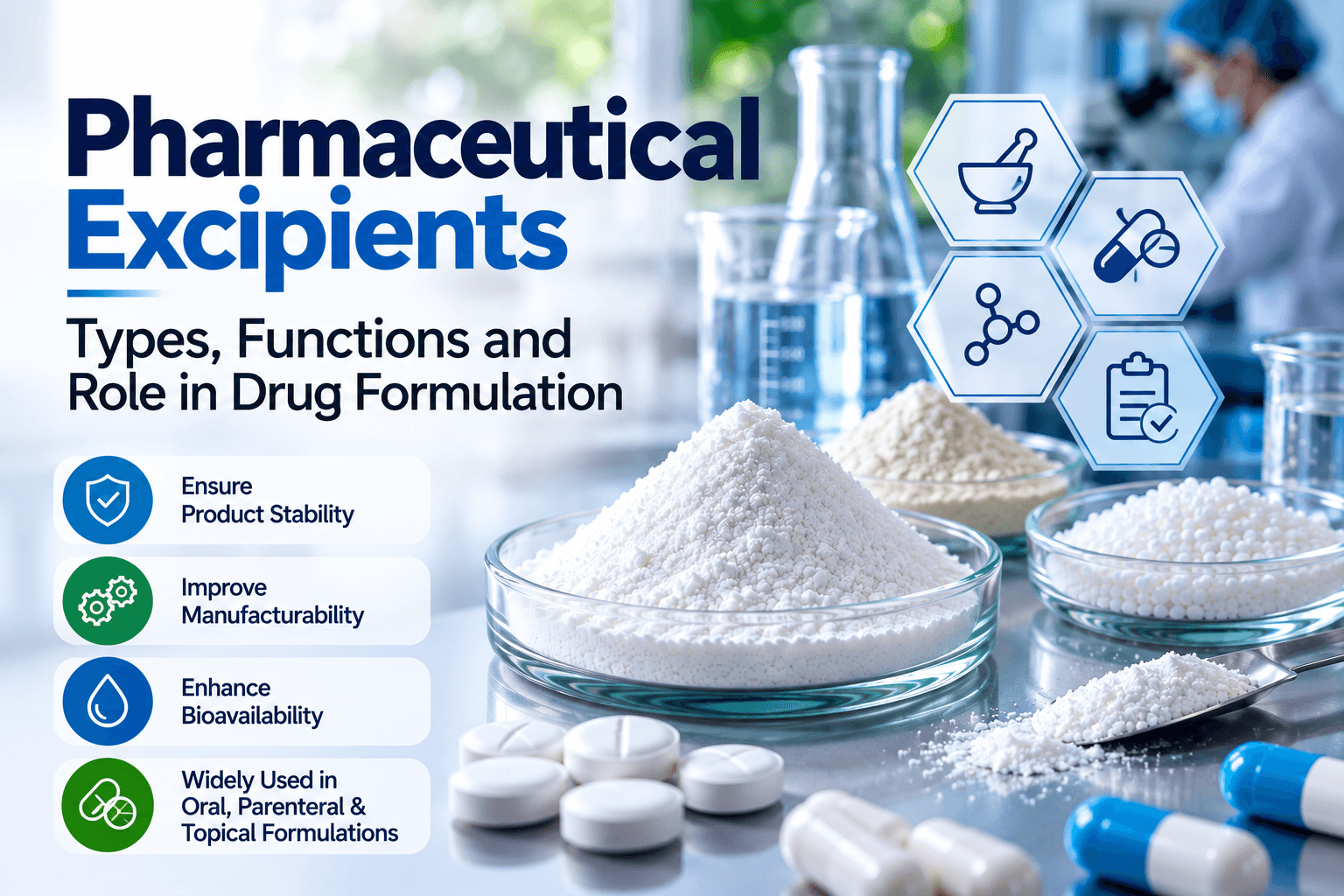
Pharmaceutical excipients are the non-API components of a finished drug product, included to give the dosage form its physical structure, control how and when the API is released, and make the product manufacturable, stable and acceptable to patients.
Although regulatory documentation often refers to excipients as “inactive ingredients,” that label describes their lack of direct pharmacological action against the condition being treated, not their impact on the product. The specific excipients chosen, their grades, and their proportions in a formulation directly affect tablet hardness, disintegration time, dissolution rate, stability during storage, and ultimately how much and how quickly the API becomes available in the body — which is why excipient choice is documented and justified as part of every regulatory drug submission.
What Are Fillers and Diluents, and Which Excipients Serve This Role?
Fillers, also called diluents, add bulk to a formulation so that a tablet or capsule containing a small amount of a potent API still reaches a practical, handleable size, while also contributing to the compressibility and flow properties of the powder blend.
Microcrystalline cellulose is one of the most widely used fillers, valued for its excellent compressibility and binding ability, which is why it is also sometimes classed as a binder. Lactose monohydrate is another standard filler, prized for its flow and compression properties, though formulators must consider it for patients with lactose intolerance or in Maillard-reaction-sensitive formulations. Mannitol, a sugar alcohol, is often chosen for chewable tablets and orally disintegrating formulations because of its pleasant taste and low hygroscopicity compared with other sugar-based fillers.
What Are Binders, and How Do They Hold a Tablet Together?
Binders are excipients that hold powder particles together during wet or dry granulation and subsequent compression, giving the tablet enough mechanical strength to survive packaging, shipping and handling without crumbling.
Povidone, commonly supplied as PVP K30, is a widely used binder added either as a dry powder or dissolved in a granulating solvent, prized for strong binding at relatively low usage levels. HPMC (hydroxypropyl methylcellulose) also serves as a binder in many formulations, in addition to its separate role as a film-coating polymer, making it one of the more versatile excipients in a formulator's toolkit. The right binder concentration is a balancing act: too little and the tablet is friable; too much and it may disintegrate and dissolve too slowly.
What Are Disintegrants, and Why Does Croscarmellose Sodium Matter?
Disintegrants are included in a tablet formulation specifically to make the compressed tablet break apart quickly once it contacts gastrointestinal fluid, exposing the API's surface area so it can dissolve and be absorbed rather than passing through the body as a slow-dissolving mass.
Croscarmellose sodium is one of the most widely used “superdisintegrants,” valued for achieving rapid tablet breakup at a lower usage level than older disintegrants like plain starch, working by rapidly absorbing water and swelling to pull the tablet matrix apart. Disintegrant choice and level are especially critical for immediate-release formulations, where rapid onset of dissolution is a key performance target, and are deliberately minimised or excluded in sustained-release formulations designed to release the API slowly over time.
What Are Lubricants and Glidants, and Why Does Magnesium Stearate Matter?
Lubricants reduce friction between the powder blend and the tableting equipment, preventing the tablet from sticking to the punches and dies during compression, while glidants improve powder flow so the blend feeds consistently into the tablet press.
Magnesium stearate is the most widely used tablet lubricant, effective at very low concentrations, typically under one percent of the formulation. Because it is hydrophobic, however, too much magnesium stearate can slow water penetration into the tablet and delay disintegration and dissolution, which is why formulators carefully control both the lubricant level and the mixing time to avoid over-lubrication.
What Are Coating Agents and Solubility Enhancers Used For?
Coating agents are applied as a thin film over a finished tablet or bead to protect the API from moisture and light, mask unpleasant taste, make the tablet easier to swallow, or control where and how fast the drug is released, while solubility enhancers help poorly water-soluble APIs dissolve more effectively.
HPMC is one of the most common film-coating polymers, used both for simple cosmetic and protective coatings and, at different substitution grades, for controlled-release coatings that slow drug release over an extended period. Polyethylene glycol (PEG) serves multiple roles across formulation: as a plasticiser in film coatings, as a solubility-enhancing excipient in certain oral and topical formulations, and as a base for suppositories and some semi-solid dosage forms, with the specific molecular weight grade (commonly PEG 400, PEG 4000 or PEG 6000) chosen to match the required viscosity and melting behaviour.
How Should Formulators Select the Right Excipient Grade?
Formulators should select excipient grade based on the specific functional requirement of the formulation — particle size and compressibility for fillers, viscosity grade for binders and coating polymers, molecular weight for PEG — rather than treating excipients within the same chemical family as interchangeable.
Because grade differences can meaningfully change how an excipient performs, formulators typically specify not just the excipient name but the exact grade (for example, a specific HPMC viscosity grade or PEG molecular weight) in the formulation record, and any change requires requalification through compressibility, disintegration, dissolution or stability testing as appropriate. Sourcing from qualified manufacturers with consistent, batch-to-batch quality is just as important as the initial grade selection, since variability in particle size distribution or viscosity between batches of nominally the same excipient grade can still affect manufacturability and product performance.
How Should Buyers Source Pharmaceutical Excipients?
Buyers should source pharmaceutical excipients by confirming the exact grade and compendial specification needed, verifying documentation, and sourcing from manufacturers with demonstrated GMP and batch consistency. Six practical steps follow.
- 1
Confirm the exact excipient and grade needed
Specify not just the excipient (e.g. HPMC) but the exact grade (viscosity, substitution type) your formulation requires.
- 2
Confirm compendial compliance
Verify the material meets the relevant USP-NF, Ph. Eur. or IP monograph your regulatory filing references.
- 3
Request the certificate of analysis and safety data sheet
Check every batch against your approved specification before release to production.
- 4
Confirm GMP sourcing and batch traceability
Work with suppliers who can document the manufacturing facility and provide lot traceability for audit and regulatory purposes.
- 5
Request samples before committing to bulk volume
Test any new excipient source or grade against your formulation at lab scale before placing a full production order.
- 6
Never change grade or source without requalification
Treat any excipient grade or supplier change as a formulation change requiring the appropriate testing and documentation.
How Did Modern Pharmaceutical Excipients Develop?
Pharmaceutical excipients evolved from simple, often improvised fillers and binders used in early compressed tablets in the late nineteenth and early twentieth centuries into a rigorously standardised, compendially regulated category of ingredients as the pharmaceutical industry professionalised through the twentieth century.
Early tablets relied on basic materials like starch and sugar for bulk and binding, with little formal characterisation of how these materials affected drug release. As understanding of dissolution, bioavailability and bioequivalence advanced through the mid-twentieth century, particularly after several well-documented cases where formulation and excipient changes caused clinically significant shifts in drug absorption, regulators and compendial bodies developed formal monographs and specifications for excipients, and functional categories such as superdisintegrants (like croscarmellose sodium) and high-performance binders (like povidone) were developed specifically to improve manufacturability and drug performance. Today, excipient selection and qualification is a core, documented part of pharmaceutical development, supported by compendial standards, regulatory databases like the FDA's Inactive Ingredient Database, and increasingly sophisticated formulation science.
Frequently asked questions
What is a pharmaceutical excipient?+
A pharmaceutical excipient is any ingredient in a finished drug product other than the active pharmaceutical ingredient (API) itself. Excipients give tablets, capsules and other dosage forms their physical structure, help them break apart and release the drug correctly, protect the API during manufacturing and storage, and make the product easier and safer to manufacture.
Are excipients really inactive?+
Excipients are often called “inactive ingredients,” but the term refers to pharmacological inactivity against the disease being treated, not to a lack of effect on the product. The choice of excipient, its grade, and its particle size can measurably change how fast a tablet disintegrates, how well the API dissolves, and ultimately how much drug reaches the bloodstream, which is why excipient selection is a formal part of formulation development and regulatory submission.
What is the difference between a binder and a filler?+
A filler, or diluent, adds bulk so that a low-dose API can be formed into a practically sized tablet or capsule, while a binder holds powder particles together during granulation and compression so the tablet does not crumble. Microcrystalline cellulose and lactose monohydrate are common fillers; povidone (PVP) and HPMC are common binders, and some excipients, including microcrystalline cellulose, can serve both roles depending on the formulation.
Why do tablets need a disintegrant?+
A disintegrant is included so that a compressed tablet breaks apart quickly once it reaches gastrointestinal fluid, exposing the API so it can dissolve and be absorbed rather than passing through the body as an intact, poorly dissolving mass. Croscarmellose sodium is a widely used “superdisintegrant” valued for achieving rapid breakup at a low usage level compared with older disintegrants.
Can one excipient grade be substituted for another without reformulation?+
No. Excipients from the same chemical family often come in multiple grades that differ in particle size, molecular weight, viscosity or purity — for example, polyethylene glycol is supplied as PEG 400, PEG 4000 or PEG 6000, each suited to a different role — and substituting one grade for another can change how a formulation behaves even though the underlying chemical is the same. Any grade change should go through the same qualification and stability testing as a new excipient.
Does Chelora Pharmachem supply pharmaceutical excipients?+
Yes. Chelora Pharmachem supplies a range of pharmaceutical excipients, including microcrystalline cellulose, povidone (PVP K30), croscarmellose sodium, HPMC, magnesium stearate, lactose monohydrate, mannitol, polyethylene glycol (PEG) and pharma-grade gelatin, each sourced from qualified manufacturers and supplied with a certificate of analysis and safety data sheet.
Sourcing Pharmaceutical Excipients?
Chelora Pharmachem supplies a verified range of pharmaceutical excipients, intermediates and vitamin ingredients from Mumbai, with every product checked name-to-CAS-to-formula and shipped with a certificate of analysis and safety data sheet. Current excipients include Microcrystalline Cellulose, Povidone (PVP K30), Croscarmellose Sodium, HPMC, Magnesium Stearate, Lactose Monohydrate, Mannitol, Polyethylene Glycol (PEG, including 400/4000/6000 grades) and pharma-grade Gelatin. Sample quantities are available for QC testing before bulk orders, and the team typically responds to quote requests within one business day.
- #pharmaceutical excipients
- #tablet formulation
- #MCC
- #povidone
- #croscarmellose sodium
- #HPMC
- #magnesium stearate