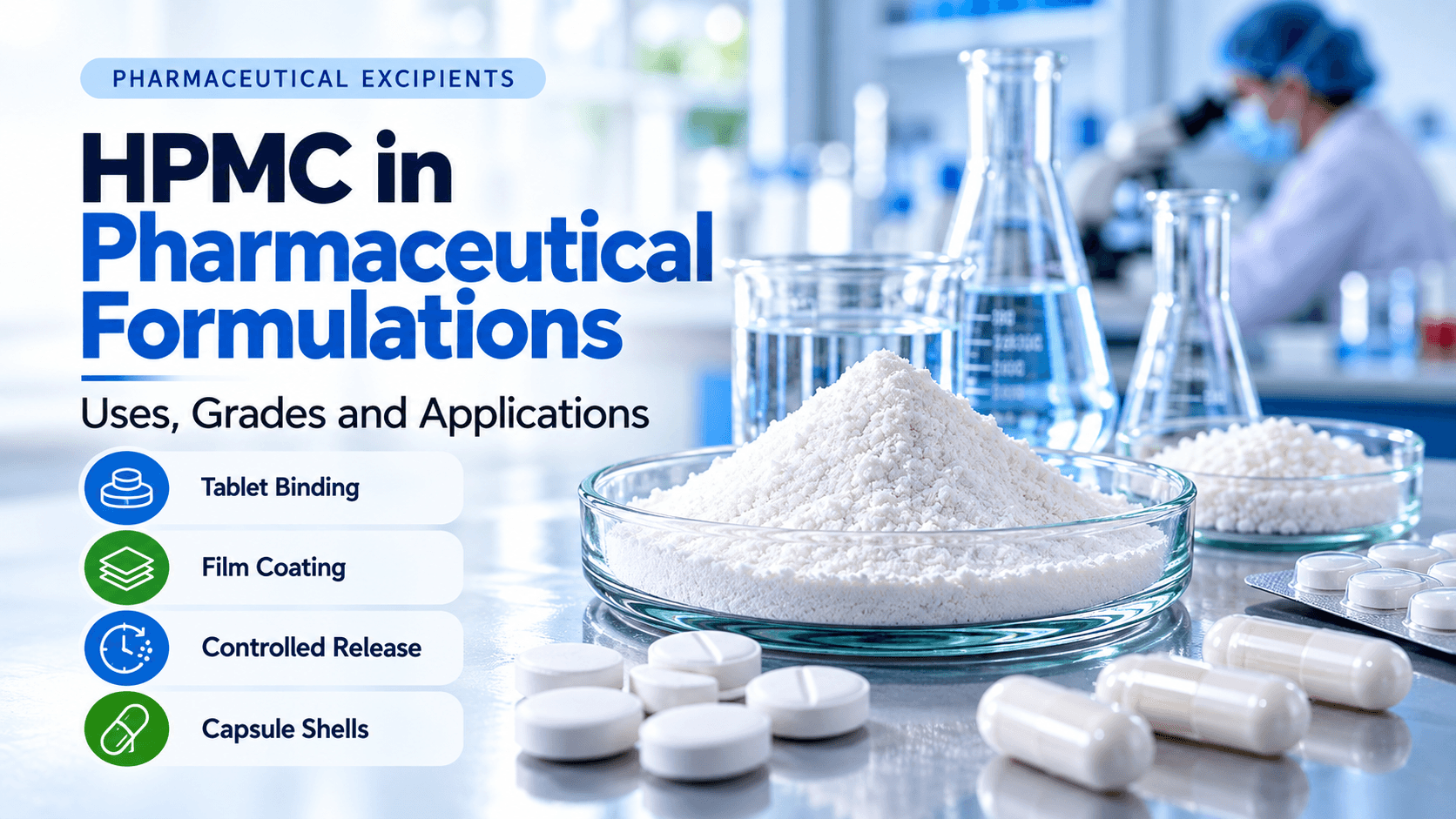
HPMC, or hydroxypropyl methylcellulose (also called hypromellose), is a semi-synthetic, non-ionic cellulose ether that has become one of the most versatile excipients in pharmaceutical formulation. Produced by chemically modifying purified cellulose, HPMC dissolves in cold water to form clear, viscous solutions, forms strong flexible films, and swells into a gel layer when it hydrates. These properties allow formulators to use HPMC in pharmaceutical formulations as a tablet binder, a film-coating polymer, a rate-controlling matrix former for extended-release tablets, a viscosity enhancer in ophthalmic and topical products, and a vegetarian capsule shell material. Because HPMC is available in several substitution types and a wide range of viscosity grades, choosing the right one has a direct effect on dissolution, stability, manufacturability, and regulatory compliance. This guide explains what HPMC is, where it is used, how its grades differ, and how formulators select between them.
In this article+
- 01What Is HPMC and Why Is It Widely Used in Pharmaceutical Formulations?
- 02What Are the Main Uses of HPMC in Pharmaceutical Dosage Forms?
- 03What Are the Different Grades of HPMC and How Do They Differ?
- 04How Does HPMC Control Drug Release in Extended-Release Matrix Tablets?
- 05How Has the Use of HPMC in Pharmaceutical Formulation Evolved?
- 06How Do Formulators Select the Right HPMC Grade for a Formulation?
| Product name | HPMC (Hydroxypropyl Methylcellulose) |
| Synonyms | Hypromellose, hydroxypropyl methylcellulose, HPMC |
| Chemical type | Semi-synthetic, non-ionic cellulose ether (methoxy and hydroxypropoxy substituted) |
| Functional categories | Tablet binder, film-coating polymer, extended-release matrix former, viscosity enhancer, capsule shell material |
| Solubility | Soluble in cold water, forming clear, viscous solutions |
| pH stability | Stable across a broad pH range |
| Substitution types | 2910 (E type), 2208 (K type), 2906 (F type) |
| Viscosity grades | About 3 mPa·s up to 100,000 mPa·s (2 percent aqueous solution at 20 °C) |
| Pharmacopoeial status | Listed in USP-NF, European Pharmacopoeia and Japanese Pharmacopoeia; in the FDA Inactive Ingredient Database |
| Main dosage forms | Tablets (binding, coating, matrix), ophthalmic and topical products, liquids and gels, vegetarian capsules |
| Available from Chelora Pharmachem | Pharmaceutical excipient range |
What Is HPMC and Why Is It Widely Used in Pharmaceutical Formulations?
HPMC is a cellulose ether in which some of the hydroxyl groups on the cellulose chain are replaced with methoxy and hydroxypropoxy groups, giving a polymer that is soluble in cold water, stable across a broad pH range, and generally regarded as inert and safe for oral, ophthalmic, and topical use. It is widely used because a single polymer family can perform many different roles in a dosage form.
Several characteristics explain its popularity among formulators. HPMC is non-ionic, so it is far less likely than ionic polymers to interact with charged drug molecules or other excipients. It is stable over a wide pH range, which makes it suitable for drugs that must pass from the stomach to the intestine. It is also compatible with both aqueous and dry processing routes, including direct compression, wet granulation, and aqueous film coating. In addition, HPMC is listed in the major pharmacopoeias, including the USP-NF, the European Pharmacopoeia, and the Japanese Pharmacopoeia, and it appears in the FDA Inactive Ingredient Database for multiple routes of administration, which supports its acceptance by regulators worldwide. For a manufacturer, the practical result is one well-characterised excipient family that can often replace several others.
What Are the Main Uses of HPMC in Pharmaceutical Dosage Forms?
The main uses of HPMC in pharmaceutical formulations are as a tablet binder, a film-coating polymer, a controlled-release matrix former, a viscosity-increasing agent for liquids and gels, and a capsule shell material. Each role relies on a different combination of viscosity grade and substitution type.
As a binder, HPMC holds powder particles together during wet granulation or dry compression so that tablets have adequate hardness and low friability. Published excipient references commonly cite binder use levels in the range of roughly 2 to 5 percent by weight of the tablet. In film coating, low-viscosity grades are dissolved in water or a water-alcohol mixture and sprayed onto tablets to form a thin, uniform film that masks taste, improves appearance, protects against moisture, and makes tablets easier to swallow. The shift from organic-solvent to aqueous coating systems made HPMC a standard choice, because it forms films without the safety and environmental concerns of flammable solvents.
In extended-release matrix tablets, higher-viscosity grades are blended with the drug and compressed so that the tablet swells on contact with fluid and releases the drug gradually over many hours. In liquid and semi-solid products, HPMC acts as a thickener, suspending agent, and stabiliser; in ophthalmic solutions such as artificial tears it increases residence time on the eye surface. HPMC is also the base material for vegetarian capsule shells, which have a lower equilibrium moisture content than gelatin capsules and can therefore suit moisture-sensitive drugs and plant-based product claims.
What Are the Different Grades of HPMC and How Do They Differ?
HPMC grades differ mainly in two ways: the substitution type, which describes the proportion of methoxy and hydroxypropoxy groups on the polymer, and the viscosity grade, which reflects the polymer's molecular weight. Together these determine solubility behaviour, gelation temperature, film properties, and release-controlling strength.
Substitution types are identified by a four-digit number in the pharmacopoeias. HPMC 2910 contains about 28 to 30 percent methoxy and 7 to 12 percent hydroxypropoxy groups, and is commonly sold as the E type, widely used for binding and film coating. HPMC 2208, the K type, contains about 19 to 24 percent methoxy and 4 to 12 percent hydroxypropoxy groups and hydrates quickly to form a strong gel, which is why it is the usual choice for extended-release matrices. HPMC 2906, the F type, contains about 27 to 30 percent methoxy and 4 to 7.5 percent hydroxypropoxy groups and sits between the two in behaviour. Because the chemistry differs, a K type and an E type of the same viscosity will not necessarily behave the same way in a formulation.
| Substitution type | Methoxy (about) | Hydroxypropoxy (about) | Typical use |
|---|---|---|---|
| HPMC 2910 (E type) | 28–30% | 7–12% | Binding and film coating |
| HPMC 2208 (K type) | 19–24% | 4–12% | Extended-release matrices; hydrates quickly to a strong gel |
| HPMC 2906 (F type) | 27–30% | 4–7.5% | Sits between the E and K types in behaviour |
Viscosity grade is measured on a 2 percent aqueous solution at 20 °C and expressed in millipascal-seconds. Low-viscosity grades of roughly 3 to 15 mPa·s are normally used for film coating and for binding, because they give solutions that can be sprayed or granulated easily. Medium and high grades, ranging from about 100 up to 100,000 mPa·s, are used to control drug release from matrix tablets and to thicken liquids. Suppliers also offer particle-size variants: fine-particle grades hydrate faster and form a gel layer more quickly, which can matter for high-dose or highly soluble drugs. It is also worth distinguishing HPMC from related polymers such as hypromellose acetate succinate and hypromellose phthalate, which are chemically modified derivatives used as enteric and solubility-enhancing polymers rather than as general-purpose HPMC.
| Viscosity range (2% solution, 20 °C) | Typical use |
|---|---|
| Low: about 3 to 15 mPa·s | Film coating and binding — solutions can be sprayed or granulated easily |
| Medium to high: about 100 to 100,000 mPa·s | Controlling drug release from matrix tablets; thickening liquids |
| Fine-particle variants | Faster hydration and gel-layer formation — useful for high-dose or highly soluble drugs |
How Does HPMC Control Drug Release in Extended-Release Matrix Tablets?
HPMC controls drug release in matrix tablets by hydrating on contact with gastrointestinal fluid and forming a gel layer that slows both water entry and drug movement outward. The release rate is the net result of diffusion through this gel and gradual erosion of its outer surface.
- 1
Fluid penetrates the tablet surface
When the tablet is swallowed, gastrointestinal fluid wets the surface, and the HPMC particles at the outer edge begin to absorb water almost immediately.
- 2
The polymer hydrates and swells
Hydrated HPMC chains uncoil and entangle, and the outer region of the tablet swells as the polymer transitions from a glassy to a rubbery state.
- 3
A gel layer forms
A continuous, viscous gel layer develops around the dry core. This layer acts as a diffusion barrier, and its strength depends on the viscosity grade and concentration of HPMC used.
- 4
Drug dissolves and diffuses through the gel
Soluble drug dissolves in the penetrating fluid and diffuses outward through the gel layer, while the water front continues to move toward the tablet core.
- 5
The outer gel layer erodes
As the outermost layer becomes fully hydrated and dilute, polymer chains disentangle and dissolve away, so that the gel boundary advances inward while its thickness stays roughly balanced.
- 6
Release continues until the matrix is consumed
Drug is released by a combination of diffusion and erosion until the dry core disappears. Poorly soluble drugs tend to release mainly by erosion, while highly soluble drugs release mainly by diffusion.
How Has the Use of HPMC in Pharmaceutical Formulation Evolved?
The use of HPMC in pharmaceutical formulation has progressed from simple binding and thickening in the mid-twentieth century to sophisticated controlled-release and solubility-enhancement systems today, driven by advances in coating technology, drug delivery science, and regulatory harmonisation.
Before the widespread adoption of cellulose ethers, tablet manufacturers relied on natural binders such as starch and gums, and tablets were commonly protected with sugar coating, a slow, labour-intensive process that added considerable weight. From the mid-twentieth century, cellulose derivatives became available as consistent, synthetically controlled alternatives, and hydrophilic matrix tablets based on HPMC were described in patent literature in the early 1960s, establishing the polymer as a platform for sustained release. During the 1970s and 1980s, concerns over solvent emissions and workplace safety accelerated the move to aqueous film coating, in which HPMC was a leading film former. From the 1990s, HPMC capsules entered the market as a vegetarian alternative to gelatin, and more recently the polymer family has been extended into amorphous solid dispersions and other bioavailability-enhancement technologies. Over the same period, the major pharmacopoeias worked toward harmonised hypromellose monographs, helping manufacturers source a consistent excipient across regions. Current monograph requirements are published by the United States Pharmacopeia.
How Do Formulators Select the Right HPMC Grade for a Formulation?
Formulators select an HPMC grade by matching the polymer's substitution type and viscosity to the function required in the dosage form, then confirming the choice with experimental trials. There is no universal grade, because the same polymer behaves differently depending on the drug, the other excipients, and the process.
For film coating, the starting point is typically a low-viscosity E-type grade, since it gives sprayable solutions and smooth films; the final decision is influenced by the plasticiser, pigment load, and the spray equipment. For a matrix tablet, the drug's solubility and dose are the key inputs: a highly water-soluble drug usually calls for a higher-viscosity K-type grade at a higher polymer level to keep the gel layer intact, whereas a poorly soluble drug may need less. Particle size, the choice between wet granulation and direct compression, and the presence of other release-modifying excipients such as fillers or pH modifiers all influence the dissolution profile. Many companies therefore evaluate two or three grades in parallel and compare dissolution profiles against the target product profile before committing.
Frequently asked questions
What is HPMC used for in pharmaceutical tablets?+
In pharmaceutical tablets, HPMC is used as a binder, a film-coating polymer, and a matrix former for extended-release products. Low-viscosity grades are typically used for binding and coating, while high-viscosity grades control drug release by forming a gel layer around the tablet. This versatility is why HPMC in pharmaceutical formulations appears across immediate-release, modified-release, and coated tablet products.
What is the difference between HPMC and methylcellulose?+
Methylcellulose contains only methoxy substitution on the cellulose chain, whereas HPMC contains both methoxy and hydroxypropoxy groups. The added hydroxypropoxy substitution changes the polymer's solubility, gelation temperature, and film-forming behaviour, and generally makes HPMC more tolerant of salts and organic solvents. Both are cellulose ethers, but they are not interchangeable without evaluation in a given formulation.
Which HPMC grade is best for film coating?+
Film coating normally uses low-viscosity HPMC, commonly the 2910 or E type, because it produces sprayable solutions with good film strength. The exact grade depends on the coating system, the plasticiser used, and the spraying equipment. Formulators often test two or three viscosity grades on the actual tablet core to confirm film quality, adhesion, and appearance before scale-up.
Are HPMC capsules better than gelatin capsules?+
HPMC capsules are not universally better, but they offer specific advantages. They have a lower moisture content than gelatin, which can suit moisture-sensitive ingredients, and they are suitable for vegetarian and vegan product claims. Gelatin capsules remain widely used and may have different disintegration and dissolution behaviour, so the choice should be based on the drug, the intended market, and comparative testing.
How does HPMC viscosity affect drug release?+
Higher-viscosity HPMC forms a stronger, more slowly eroding gel layer, which generally slows drug release from a matrix tablet. Lower-viscosity grades hydrate to a weaker gel and release the drug faster. The polymer level, drug solubility, and particle size also play a role, so viscosity should be considered together with these variables rather than in isolation.
Can HPMC grades from different suppliers be substituted directly?+
Not automatically. Even when two products share a pharmacopoeial type and nominal viscosity, differences in substituent distribution, particle size, and manufacturing process can alter hydration and release behaviour. For critical applications such as extended-release tablets, any change of grade or supplier should be supported by comparative dissolution testing and the relevant regulatory assessment.
Explore Pharmaceutical Excipients from Chelora Pharmachem
Selecting the right HPMC grade starts with understanding your formulation goals. Explore the pharmaceutical excipient range from Chelora Pharmachem, or get in touch to discuss grades and specifications suited to your product.
- #HPMC
- #Hypromellose
- #Pharmaceutical Excipients
- #Controlled Release
- #Film Coating
- #Tablet Binder