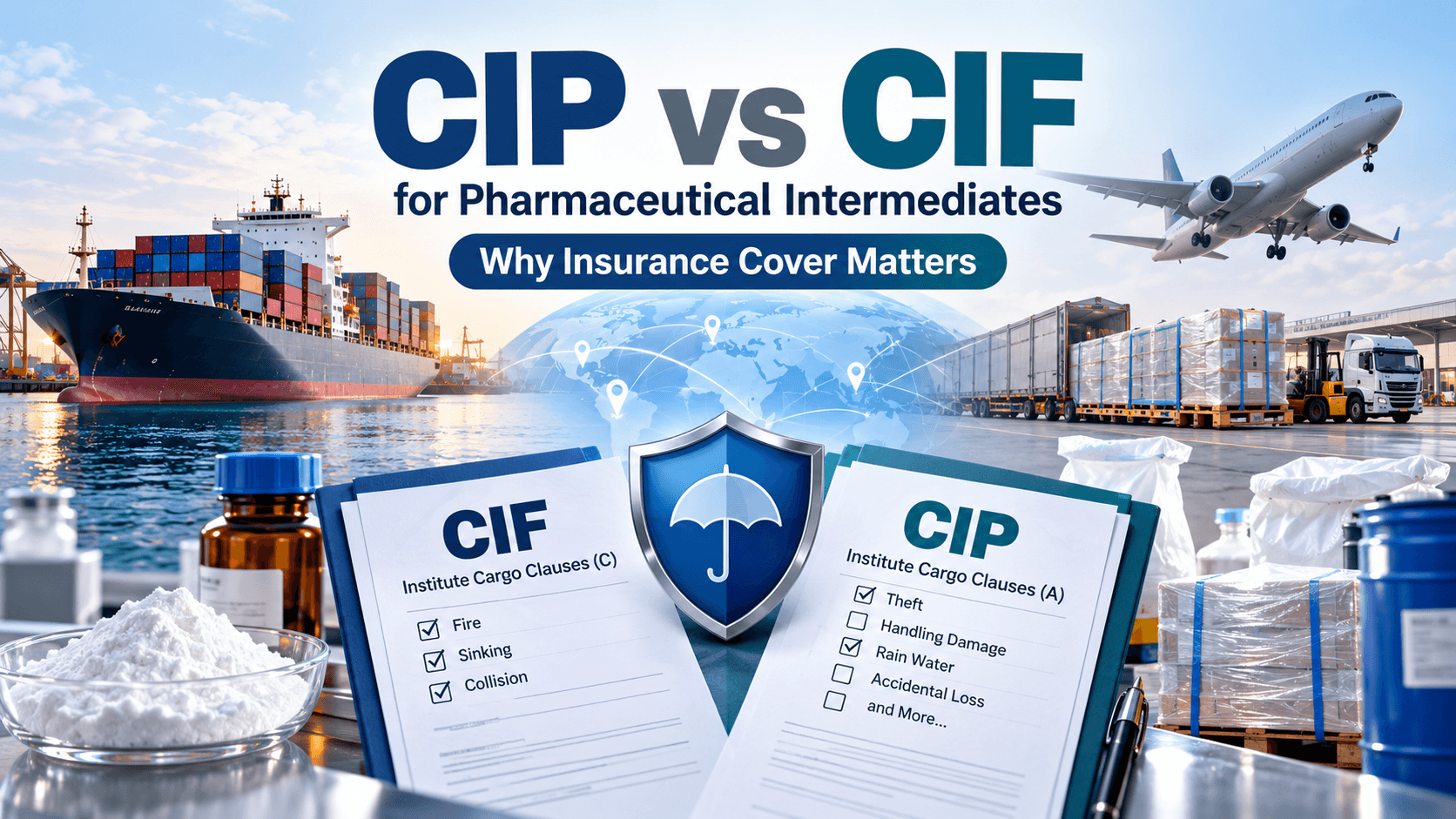
For most pharmaceutical intermediate shipments, CIP is a better choice than CIF because of insurance. Under Incoterms 2020, both rules make the seller pay freight and buy cargo insurance for the buyer's benefit, at a minimum of 110% of the contract price. But CIF requires only Institute Cargo Clauses (C), which cover a short list of major events such as fire, sinking and collision, while CIP requires Institute Cargo Clauses (A), which add theft, rain water, handling damage and other accidental physical loss. CIP also works for air freight and containers, while CIF is for sea and inland waterway transport. For high-value, small-lot or hazardous intermediates, that difference can decide whether a loss is recoverable. Even (A) cover excludes delay, inherent vice and poor packing, and war and strikes need separate cover. This guide from Chelora Pharmachem explains what each rule covers, the gaps that remain and how to protect a shipment.
In this article+
- 01How Do CIP and CIF Differ?
- 02What Do Institute Cargo Clauses (A) and (C) Actually Cover?
- 03What Does Neither Rule Cover?
- 04Why Does This Matter More for Pharmaceutical Intermediates?
- 05When Should You Insure the Cargo Yourself?
- 06How Do You Make a Claim?
- 07What Should the Contract Say?
- 08What Should Buyers Watch Into 2027?
Key takeaways
- CIF: minimum insurance under Institute Cargo Clauses (C); for sea and inland waterway transport only.
- CIP: insurance under Institute Cargo Clauses (A); usable for any mode, including air freight and containers.
- Both: cover of at least 110% of the contract price, in the contract currency, that the buyer can claim on.
- Even (A) cover excludes packing failures, inherent vice, delay, and war and strikes unless those clauses are added.
- If you already hold an open cargo policy, buying on CPT or CFR and insuring yourself can give you more control.
How Do CIP and CIF Differ?
CIP and CIF both make the seller pay freight and buy cargo insurance for the buyer, but they differ in transport mode, in where risk passes and, most importantly, in the minimum level of insurance Incoterms 2020 requires.
| Point | CIF (Cost, Insurance and Freight) | CIP (Carriage and Insurance Paid To) |
|---|---|---|
| Transport mode | Sea and inland waterway | Any mode, including air, road, rail and multimodal container moves |
| Where risk passes | When goods are on board the vessel at the port of shipment | When goods are handed to the first carrier at the agreed place |
| Seller pays freight to | Named port of destination | Named place of destination |
| Minimum insurance (Incoterms 2020) | Institute Cargo Clauses (C) or similar | Institute Cargo Clauses (A) or similar, as suits the mode of transport |
| Insured amount | At least 110% of the contract price, in the contract currency | At least 110% of the contract price, in the contract currency |
| War and strikes | Added at the buyer's request and cost, unless already included | Added at the buyer's request and cost, unless already included |
| Typical fit for pharma intermediates | Bulk or break-bulk sea cargo; acceptable if (A) cover is agreed in the contract | Air freight, LCL and FCL containers, and high-value or hazardous lots |
The insurance difference is a deliberate change in Incoterms 2020. CIF kept the lower (C) minimum because it is mainly used for bulk commodity trades, while CIP moved to (A) because it is used for manufactured goods. Buyers can still agree a higher level of cover under CIF, but they have to write it into the contract.
What Do Institute Cargo Clauses (A) and (C) Actually Cover?
Institute Cargo Clauses (C) cover only a short list of major casualties, while (A) covers all risks of physical loss or damage that are not specifically excluded. The table below summarises a standard insurer comparison of the clauses; the exact wording depends on the policy.
| Peril | (A) | (B) | (C) |
|---|---|---|---|
| Fire or explosion; stranding, grounding, sinking or capsizing | Yes | Yes | Yes |
| Overturning or derailment of land conveyance; collision | Yes | Yes | Yes |
| General average, salvage charges and jettison | Yes | Yes | Yes |
| Earthquake, volcanic eruption or lightning | Yes | Yes | No |
| Entry of sea, lake or river water into the vessel, container or place of storage | Yes | Yes | No |
| Rain water damage | Yes | No | No |
| Theft, pilferage or non-delivery of an entire package | Yes | No | No |
| Malicious damage; piracy | Yes | No | No |
| Loss or damage during loading or discharge | Yes | Total loss of a package lost overboard or dropped only | No |
| Other physical loss or damage not specifically excluded | Yes | No | No |
Take a drum of a high-value intermediate that is stolen at a transhipment hub, soaked by rain in an open yard or punctured during handling. Under (C) cover, none of those losses is likely to be recoverable. Under (A) cover, all three generally would be, subject to the policy's exclusions.
What Does Neither Rule Cover?
All three sets of Institute Cargo Clauses share general exclusions, so some losses are not recoverable under CIF or CIP, whichever level of cover applies.
General exclusions in the Institute Cargo Clauses
- Wilful misconduct of the insured.
- Ordinary leakage, ordinary loss in weight or volume, and ordinary wear and tear.
- Insufficient or unsuitable packing.
- Inherent vice or nature of the goods, for example a material that degrades by itself.
- Delay, even if it is caused by an insured peril.
- Insolvency or financial default of the shipowner or operator, and unseaworthiness in some circumstances.
- War, strikes, riots and terrorism, unless the separate war and strikes clauses are added.
For pharmaceutical intermediates, the packing, inherent vice and delay exclusions matter most. A moisture-sensitive intermediate that degrades because of a missed connection, or a hazardous liquid that leaks from unsuitable packaging, may not be recoverable under either rule. Temperature-sensitive materials usually need specialist cover agreed directly with the insurer.
Why Does This Matter More for Pharmaceutical Intermediates?
Pharmaceutical intermediates combine high value, long replacement lead times, frequent air freight, hazardous properties and strict traceability requirements, so a narrow insurance gap can turn into a large unrecovered loss.
Value. Intermediates for APIs can be expensive per kilogram, so a single lost or damaged drum can mean a significant loss.
Lead time. Replacing a qualified batch from an approved source can take weeks, and the resulting production delays are not insured under standard cargo clauses.
Air freight. Smaller lots often travel by air, where CIF is not designed to be used. CIP fits any mode of transport.
Hazards. Reactive intermediates such as thionyl chloride, chloroacetyl chloride and ethyl chloroformate need dangerous-goods packing and documentation, and losses caused by packing failures are excluded from cover.
Traceability. Buyers need intact seals, labels and batch documents to accept material into GMP stores. Physical damage to packaging can lead to rejection even when the contents may be intact. The same applies to pharmaceutical intermediates and to excipients bought for formulation.
When Should You Insure the Cargo Yourself?
Insure the cargo yourself when your company already holds an open cargo policy with suitable clauses. In that case, buying on CPT or CFR terms and insuring under your own policy usually gives you more control than relying on the seller's CIP or CIF cover.
Under CIP and CIF, the seller chooses the insurer and arranges the policy, and the buyer claims under it. Under CPT (any mode) or CFR (sea), the seller still pays freight but has no obligation to insure, so you control the cover level, deductibles and claims handling. If you stay with CIP or CIF, ask for a copy of the insurance certificate before shipment and check that it names the buyer or allows the buyer to claim.
How Do You Make a Claim?
Make a claim by recording the damage at delivery, preserving the evidence, notifying the insurer and carrier within their time limits, and submitting the full set of shipping and survey documents.
- 1
Inspect on arrival
Check the shipment before signing and note any visible damage or broken seals on the delivery receipt.
- 2
Record the evidence
Photograph packaging, labels and seals, and keep all packaging and dunnage for the surveyor.
- 3
Notify the insurer
Contact the insurer or its local claims agent promptly and request a survey.
- 4
Give notice to the carrier
Send written notice to the carrier within the time limits set in the transport contract, so recovery rights are preserved.
- 5
Quarantine the material
Hold the material in quarantine and record your quality team's assessment of whether it can be used.
- 6
Submit the claim documents
Provide the insurance certificate, commercial invoice, packing list, transport document, survey report and all correspondence.
What Should the Contract Say?
The contract should state the Incoterm with a precise named place and edition, the required insurance clauses and value, who can claim, packaging and dangerous-goods requirements, and the documents for each shipment.
Contract checklist
- Rule, named place and edition, for example "CIP [buyer's warehouse, city, country], Incoterms 2020".
- Required clauses: Institute Cargo Clauses (A) or equivalent, plus war and strikes clauses if needed.
- Insured value of at least 110% of the contract price, and the currency.
- Who is named on the certificate and where claims are payable.
- Packaging standards, dangerous-goods requirements and any temperature or humidity requirements.
- Documents per shipment: insurance certificate, invoice, packing list, transport document, COA and SDS.
What Should Buyers Watch Into 2027?
Buyers should watch for ICC news on the next Incoterms edition, changes in the cost and availability of war and strikes cover, and tightening dangerous-goods rules for reactive intermediates.
The ICC is working on the next edition of the Incoterms rules, expected around the end of the decade, and any change to the minimum insurance levels under CIF and CIP would matter to pharma buyers. In the insurance market, war and strikes cover for shipping routes affected by conflict can change at short notice. Carriers and airlines also update their rules for dangerous-goods intermediates such as acid chlorides and chloroformates, so check them before each new lane.
Frequently asked questions
What is the main difference between CIP and CIF?+
Both make the seller pay freight and buy insurance for the buyer's benefit, but they differ in insurance level and transport mode. Under Incoterms 2020, CIF requires minimum cover under Institute Cargo Clauses (C) and is for sea and inland waterway transport. CIP requires cover under Institute Cargo Clauses (A) and can be used for any mode, including air and multimodal container shipments.
Why is CIP usually better for pharmaceutical intermediates?+
Pharmaceutical intermediates are often high in value, shipped in smaller lots, sometimes sent by air and sometimes hazardous. CIP's (A) cover protects against a much wider range of losses, including theft, rain water damage and handling damage, which (C) cover does not. CIP also works for air freight and containers, where CIF is not designed to be used.
What does Institute Cargo Clauses (C) cover?+
(C) covers a limited list of major events, such as fire or explosion, stranding, grounding, sinking or capsizing, overturning or derailment of land conveyance, collision, discharge at a port of distress, general average and jettison. It does not cover theft, rain water, malicious damage or ordinary handling damage.
Does Institute Cargo Clauses (A) cover everything?+
No. (A) is close to all-risks, but it still excludes, among others, wilful misconduct of the insured, ordinary leakage and loss in weight, insufficient or unsuitable packing, inherent vice, delay, insolvency of the shipowner, and war and strikes, which need separate clauses. Check the full policy wording.
How much insurance must the seller buy under CIP or CIF?+
At least 110% of the contract price, in the currency of the contract, covering the goods from the point of delivery to at least the named destination. The insurance document must allow the buyer, or anyone else with an insurable interest, to claim directly from the insurer.
Are war and strikes covered under CIP or CIF?+
Not by default. Under both rules, the seller must arrange additional cover under the Institute War Clauses and Institute Strikes Clauses if the buyer requests it, at the buyer's cost, unless it is already included in the policy.
Is a failed quality test or contamination covered?+
It depends on the cause and the policy. Accidental physical damage or contamination may be covered under (A), but losses caused by insufficient packing, inherent vice or delay are excluded, and a quality rejection without physical damage may not be a covered loss. Ask your insurer to confirm before shipping.
Should I choose CPT or CFR and insure the cargo myself instead?+
That can make sense if your company already has an open cargo policy with suitable terms. Under CPT or CFR, the seller pays freight but has no obligation to insure, so you control the insurer, the clauses and the claims process. Under CIP or CIF you rely on a policy chosen by the seller, which is why the minimum cover level matters.
Which pharmaceutical intermediates need extra care in transit?+
Reactive or hazardous intermediates, such as acid chlorides like thionyl chloride and chloroacetyl chloride, or ethyl chloroformate, need dangerous-goods packing and documentation. Moisture-sensitive or temperature-sensitive materials need protective packaging and, where relevant, specialist cover. The SDS gives each product's transport classification.
What should I do if a pharmaceutical shipment arrives damaged?+
Note the damage on the delivery receipt, photograph packaging, seals and labels, keep all packaging, notify the insurer or its local agent promptly and request a survey, and give written notice to the carrier within the time limits in the transport contract. Quarantine the material until your quality team decides whether it can be used.
Buying Pharmaceutical Intermediates?
Share the product, grade, quantity, destination and preferred Incoterm, including any insurance requirements, and the Chelora Pharmachem team will confirm the terms and documents for your order. Every order comes with a Certificate of Analysis and a Safety Data Sheet, with export packing and paperwork, and the team typically replies within one business day.
- #Incoterms 2020
- #CIP
- #CIF
- #cargo insurance
- #Institute Cargo Clauses
- #pharmaceutical intermediates
- #air freight
- #dangerous goods
- #claims